
Freight Delivery to a School or University
Plan school or university freight delivery by confirming the approved receiving point, campus access, equipment, paperwork, timing, and carrier-specific services.
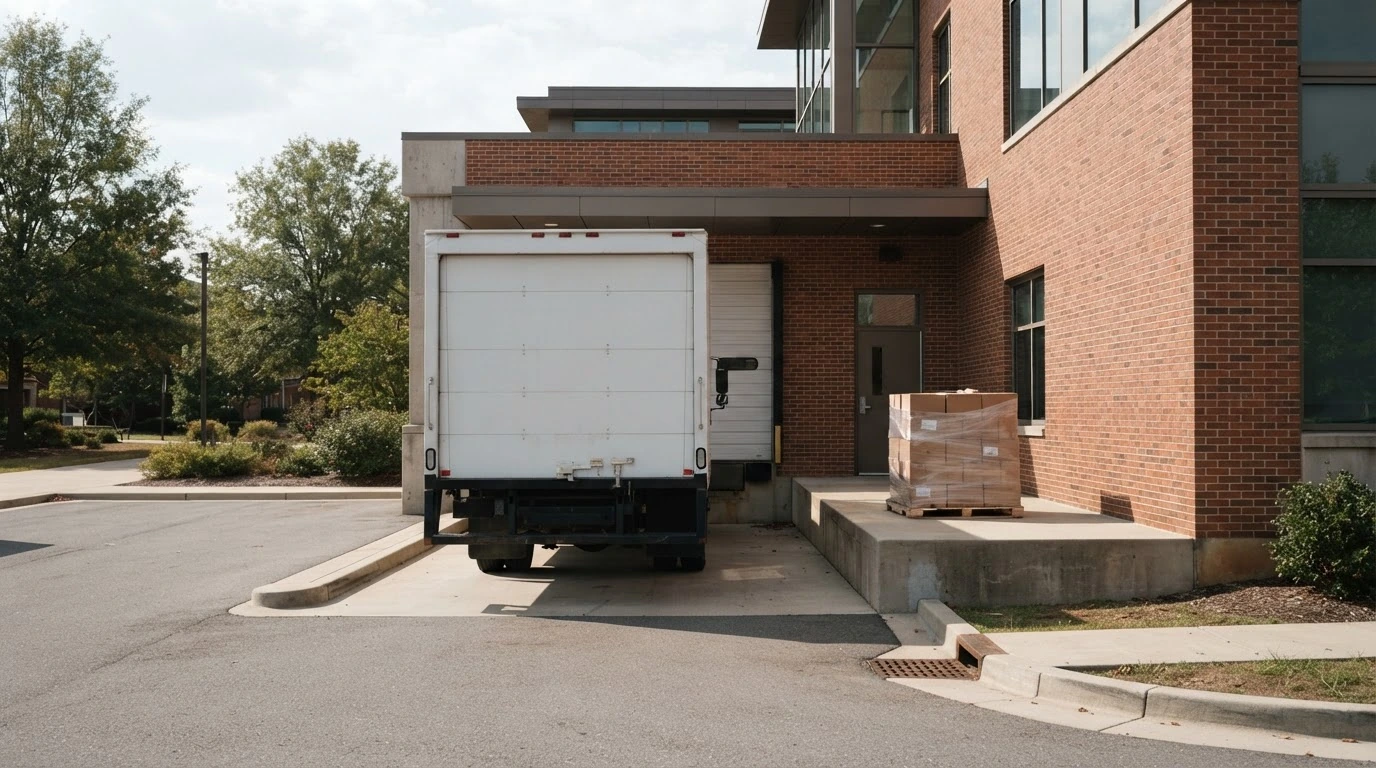
Freight delivery to a school or university should be planned around the institution’s actual receiving process, not just its street address. Before booking, confirm the approved receiving point, delivery hours, appointment or notification procedure, on-site contact, unloading capability, paperwork, and truck-access restrictions. Then match those facts to the selected carrier’s current service rules.
A school name does not reveal which services are included. Old Dominion’s current accessorial brochure groups schools under limited-access pickup or delivery, while Estes publishes distinct school-pickup and school-delivery codes. The applicable quote and carrier terms control the classification and charge for a specific shipment.
Confirm the receiving point before requesting a rate
A campus address may contain a central warehouse, academic buildings, residence halls, athletic facilities, maintenance areas, and pedestrian-only routes. The purchasing department’s address may not be the location where a freight vehicle is allowed to unload.
Ask the institution’s purchasing, facilities, warehouse, mail services, or receiving team to confirm:
- the exact freight address, entrance, building, dock, or designated drop point;
- receiving days and hours, including closures and academic breaks;
- whether an appointment, advance notice, or scheduling portal is required;
- the department and contact authorized to accept and sign for the freight;
- purchase-order, work-order, bill-of-lading, or campus-reference requirements;
- whether a usable dock, forklift, or other unloading method is available;
- gate, security, parking, vehicle-size, and route restrictions; and
- the point where the carrier’s handoff ends.
Do not use a classroom, office, department, or residence-hall address unless the institution confirms that it can receive the shipment. If central receiving is required, use the address and references that team provides.
Receiving policies vary by institution
Official campus and school-district instructions show why the destination must be contacted directly.
Portland State University requires freight headed to its specified loading dock to be scheduled at least 24 hours, or one business day, in advance. Its instructions require a work order and warn that an unscheduled delivery may be delayed or refused. The page also lists institution-specific handling and storage charges. Those requirements belong to Portland State; they are not a universal campus policy.
Newport-Mesa Unified School District publishes assigned delivery days for stores orders and normal outside-vendor receipts. Its instructions designate one MPR drop site per school and require a signature. A school with several entrances may therefore have only one approved freight handoff point.
Purdue University defines freight in its process as crated or palletized material or equipment. Its outbound workflow uses a Freight Shipping Form and routes prepared freight through the Materials Management and Distribution Center. Purdue separately directs hazardous-material shippers to its Environmental Health and Safety department and sends international shipments through university export and customs review when applicable.
These examples identify questions to ask. They do not establish the rules at another school or university.
The carrier decides how the stop is classified
The institution and the carrier answer different questions. The institution explains where and when it will accept freight. The carrier determines how the stop and requested services are treated under its quote, tariff, or service rules.
Old Dominion’s 2026 accessorial brochure includes schools in its limited-access pickup-or-delivery category. Estes’ published rate-request code list instead shows school pickup and school delivery as specific accessorials. Estes also lists appointment, notification, liftgate, inside-delivery, and residential codes separately.
Three booking rules follow:
- Disclose that the destination is a school or university. Do not assume a commercial-looking address will receive standard dock treatment.
- Use the selected carrier’s terminology. One carrier may apply a broad limited-access delivery category, while another may use a school-specific service.
- Select each additional need separately. A school or limited-access classification does not, by itself, confirm equipment, appointment, notification, or placement service.
If the quote flow does not make the correct campus option clear, provide an accurate description of the facility and confirm the carrier’s treatment before dispatch.
Separate location type from delivery service
Use the receiving facts to resolve each service question. Definitions and availability remain carrier-specific.
| Confirmed condition | Question to resolve before booking |
|---|---|
| The carrier treats the stop as a school or limited-access location | Which school, campus, or limited-access service applies? |
| The receiver requires a scheduled date or time window | Is appointment delivery required, and who arranges it? |
| The receiver wants a call or message before arrival | Is notification available as a separate service? |
| The receiving point lacks a suitable dock or unloading method | Is liftgate service available and suitable for the packaged handling unit? |
| The receiver expects movement beyond the ordinary handoff point | Is inside delivery available, and what endpoint does the service cover? |
| Entry requires screening, credentials, a gate code, or an escort | What details must be supplied before dispatch? |
| The requested building cannot accept the vehicle or handling unit | Must the shipment go to central receiving or use a specialized delivery arrangement? |
Do not collapse these questions into one checkbox. Liftgate and inside delivery solve different problems, and either may be needed independently; the liftgate-versus-inside-delivery guide explains that distinction. Likewise, an appointment and a general arrival notification are separate entries in Estes’ published accessorial list.
Do not classify a residence hall by intuition
A residence hall houses students, but its name alone does not establish how a carrier will classify the stop. The correct treatment depends on the carrier’s rules and the real receiving arrangement.
Confirm whether the shipment is going to a central dock, campus warehouse, or residence-hall entrance; whether the building has a freight-receiving operation; whether a truck can reach the approved point; and what unloading equipment is available. Then let the selected carrier determine whether school, limited-access, residential, or another service applies.
The same approach applies to satellite campuses, charter schools, district warehouses, athletic complexes, and research facilities: report the facility and access conditions instead of guessing the service label.
Define the physical handoff
“Deliver to the university” is not a complete unloading instruction. The booking should state where the freight vehicle can go, how the handling unit will leave the trailer, and where carrier responsibility is expected to end.
Vehicle to dock or ground
Confirm whether the approved receiving point has a usable dock or receiver-provided unloading equipment. If it does not, give the carrier the packaged dimensions, weight, balance, and handling-unit type so liftgate availability and suitability can be evaluated. Freight that requires a forklift, crane, rigging, or specialized crew needs a service arrangement that expressly covers that work.
Handoff point to final destination
If the institution expects movement beyond the dock or ordinary unloading position, describe the requested endpoint and route. Include doors, thresholds, turns, elevators, stairs, surface conditions, and access controls that could affect handling.
Do not promise classroom, office, laboratory, upper-floor, or room-of-choice placement unless the booked service expressly includes it. The carrier handoff may end at central receiving even when the institution plans to move the goods elsewhere afterward.
Campus entrance to receiving point
Provide the approved entrance and service route. Report security check-in, pedestrian zones, construction, low clearances, narrow turns, parking restrictions, and school-day traffic controls. The carrier needs these facts to evaluate the stop; a route used by campus vehicles is not automatically suitable for every freight truck.
Booking sequence for school or university freight
- Obtain the institution’s instructions. Confirm the freight address, entrance, receiving point, hours, contact, references, and scheduling process.
- Describe the freight as packaged. Provide the commodity, piece and handling-unit count, finished dimensions, weight, and freight class when known.
- Confirm unloading capability. Record the usable dock, forklift, or other receiver-provided equipment, or identify the need for the carrier to evaluate liftgate service.
- Define the requested endpoint. Separate dock or ground-level handoff from movement beyond that point.
- Disclose facility and access conditions. Include school or university status, gates, screening, route limitations, and receiving constraints.
- Review the returned quote. Verify that the applicable school or limited-access treatment and every required appointment, notification, liftgate, inside-delivery, or other service appear in the booking.
- Transmit consistent instructions. Use the verified address, receiving contact, and required references in the shipment record and delivery instructions.
This process does not predict the accessorials a carrier will apply. It gives the carrier and receiver the facts needed to plan the stop.
Exceptions that need separate planning
Hazardous materials
Campus approval does not replace transportation requirements. Purdue tells its university shippers to contact Environmental Health and Safety before shipping freight that contains chemicals, dry ice, or other hazardous materials. Regulated freight requires qualified preparation and accurate commodity disclosure.
International freight
Customs and export obligations depend on the shipment, direction, commodity, destination, value, and parties. Purdue states that its Export Controls office reviews international shipments for possible U.S. export-license needs and that customs brokers may be required. That is Purdue’s process, not a universal timeline or a substitute for shipment-specific compliance review.
Oversized, unusually heavy, or installation freight
Do not infer handling capacity from the presence of a dock. Confirm whether the approved receiving point can accept the packaged dimensions, weight, and handling method. Crane work, rigging, multi-person handling, unpacking, assembly, installation, calibration, and debris removal require services that expressly include those tasks.
Breaks, events, and temporary restrictions
Receiving availability can change during holidays, academic breaks, move-in, commencement, athletic events, and campus construction. Reconfirm time-sensitive instructions before dispatch.
School freight quote checklist
Gather these details before requesting the rate:
- origin and destination addresses and ZIP codes;
- institution name, facility type, approved entrance, and receiving point;
- receiving days, hours, closures, appointment process, and contact;
- purchase-order, work-order, department, and campus references;
- commodity description and freight class when known;
- piece count, handling-unit count, packaged dimensions, and weight;
- packaging type, stackability, and special-handling restrictions;
- dock, forklift, and other unloading-equipment availability;
- required handoff point and any requested movement beyond it;
- school, limited-access, appointment, notification, liftgate, inside-delivery, or other service questions;
- gate, credential, parking, clearance, and vehicle restrictions; and
- hazardous-material, temperature, customs, export-control, or installation needs.
A rate based on an ordinary commercial-dock assumption is not equivalent to a quote that reflects the campus’s real receiving plan.
Build the quote around verified receiving details
Successful school and university freight delivery starts with two checks: the institution’s current receiving instructions and the selected carrier’s current service rules. Confirm the handoff location, timing, paperwork, equipment, access, and requested endpoint before the truck is dispatched.
Shipocity is backed by a team with more than 40 years of combined logistics experience. Through established industry relationships, the platform helps businesses compare competitive freight rates for their specific shipment.
When those details are ready, build a Shipocity quote with the required delivery services.