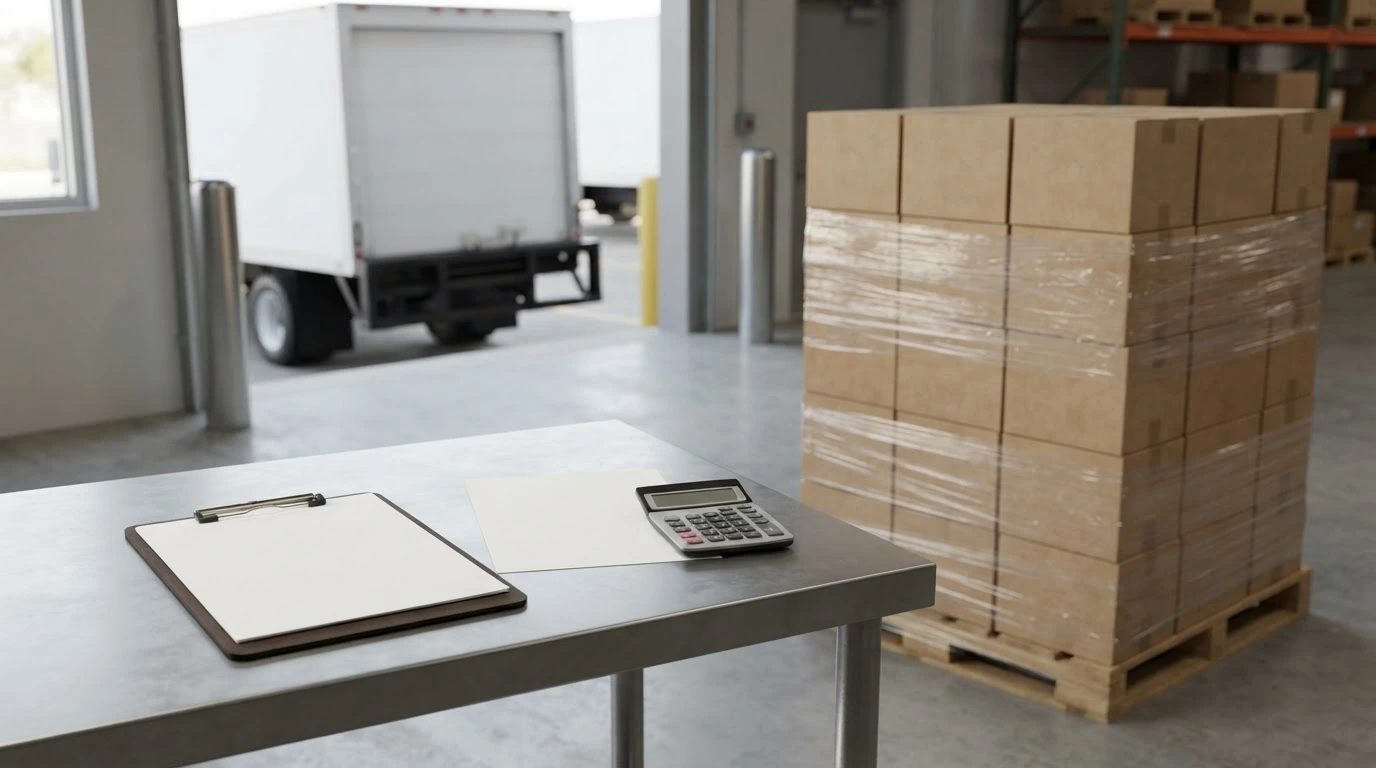
Liftgate vs Inside Delivery
Compare liftgate and inside delivery, understand what each freight service covers, and decide whether a shipment needs one service, both, or neither.
Liftgate service and inside delivery solve two different parts of a freight delivery. A liftgate moves freight vertically between the trailer and ground level. Inside delivery moves freight beyond the carrier’s standard loading or unloading position, subject to the carrier’s rules and what can be handled safely.
One service does not automatically include the other. A shipment may need a liftgate, inside delivery, both services, or neither.
The difference at a glance
| Question | Liftgate service | Inside delivery |
|---|---|---|
| What problem does it solve? | The site cannot move the freight between trailer height and ground level. | The freight must be moved beyond the normal dockside or immediately adjacent unloading position. |
| What does the carrier provide? | A truck or trailer equipped with a power-operated platform. | Additional movement of the freight, within the carrier’s service definition and operating limits. |
| Does it bring freight into a room? | No. A liftgate only raises or lowers the freight. | Not necessarily. “Inside” does not promise room-of-choice placement, unpacking, assembly, stairs, or unrestricted movement through a building. |
| Is it part of standard service? | Usually treated as an accessorial service. | Usually treated as an accessorial service. |
| Can you request both? | Yes. | Yes. |
The simplest way to remember the distinction is this:
- Liftgate answers: How will the freight get between the trailer and the ground?
- Inside delivery answers: Where must the freight go after it leaves the carrier’s standard unloading position?
What liftgate service includes
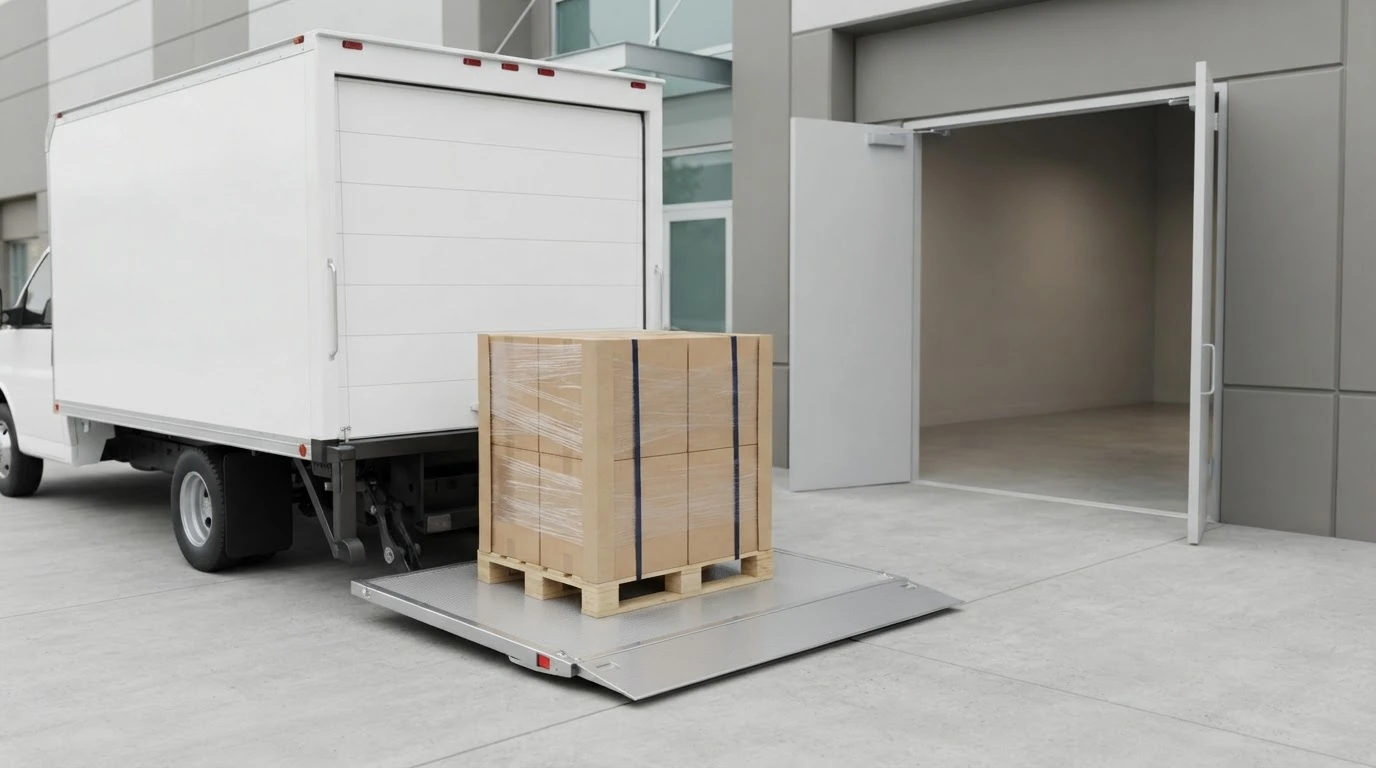
A liftgate is a power-operated platform attached to the rear of a truck or trailer. It lifts freight from street or ground level to the trailer floor, or lowers it in the opposite direction. Estes describes the same basic function in its current freight FAQ, while FedEx advises shippers to request a liftgate when a location has no loading dock.
Liftgate service may be appropriate when a pickup or delivery site lacks a dock, forklift, or other suitable unloading equipment. Whether the shipment can actually use the liftgate depends on more than the address. The carrier must be able to provide a liftgate-equipped vehicle, and the handling unit must be compatible with that carrier’s equipment and safety rules.
A liftgate does not mean the driver will move the freight across a parking lot, through a doorway, down a hallway, or to a particular room. Once the shipment reaches ground level, the liftgate’s job is complete.
What inside delivery includes
Inside delivery is easy to misunderstand because the name sounds more expansive than many carrier rules are.
Carrier definitions differ. Estes defines inside pickup and delivery as service to a location other than the shipping dock. Old Dominion describes it as movement beyond the immediately adjacent truck loading or unloading position in one of its current tariff rules. Those definitions show why “inside” should not be read as a universal promise to place freight wherever the receiver chooses.
The actual service boundary can depend on the carrier, tariff, facility, freight, available equipment, access route, and whether the requested movement is safe and practical. Stairs, elevators, narrow doors, uneven surfaces, long carries, room-of-choice placement, debris removal, unpacking, and assembly may fall outside standard inside-delivery service or require another final-mile product.
Before booking, describe the requested endpoint in physical terms. “Move one pallet through the ground-level receiving door to the first accessible position” is more useful than simply saying “inside.” The carrier can then confirm whether its service covers the request.
When you need a liftgate, inside delivery, both, or neither
Use the conditions at the stop to choose the service rather than treating the two options as substitutes.
Liftgate only
Choose liftgate service when the location cannot unload at trailer height, but a ground-level handoff at the carrier’s normal delivery position is acceptable.
For example, a commercial location without a dock may be ready to take control of the pallet as soon as the liftgate places it on a suitable ground surface. The carrier does not need to move it farther into the property.
Inside delivery only
Choose inside delivery when the site can handle freight at trailer height but needs the carrier to move it beyond the standard loading or unloading position.
This might apply at a dock-equipped facility where the requested handoff point is beyond the dock. It still requires confirmation that the requested movement falls within the carrier’s inside-delivery rules.
Both services
Choose both when the freight must first be lowered to ground level and then moved beyond the standard unloading position.
A ground-level commercial entrance without a dock is a common decision pattern: the liftgate handles the height change, and inside delivery covers the additional movement. Both services should be included in the quote request rather than assuming one includes the other.
Neither service
You may need neither when the location has an appropriate dock or unloading equipment and can accept the freight at the carrier’s standard handoff point.
| Conditions at the stop | Likely selection |
|---|---|
| No dock or unloading equipment; ground-level handoff is enough | Liftgate |
| Dock or suitable unloading equipment; movement beyond the normal handoff point is required | Inside delivery |
| No dock or unloading equipment; movement beyond the normal handoff point is also required | Liftgate and inside delivery |
| Dock or unloading equipment; standard handoff is acceptable | Neither |
This table is a planning tool, not a substitute for the carrier’s tariff or an operating review of the actual stop.
Why the distinction affects the quote
Liftgate and inside delivery are normally separate accessorials. Current carrier materials list them separately: Old Dominion’s 2026 accessorial brochure assigns them different tariff items, and the FedEx Freight tariff index does the same. That separation matters even when both services happen during one delivery.
Do not rely on a generic online fee range. Accessorial pricing can depend on the carrier, applicable tariff, shipment weight, minimum or maximum charges, location, direction of service, and customer-specific pricing agreement. Compare the applicable liftgate and inside-delivery charges in the shipment-specific quote rather than treating an industry estimate as the price for your lane.
Requesting the service during quoting also helps the carrier plan the stop. Estes warns that an unplanned liftgate or inside-delivery requirement may add a charge, require approval, or cause freight to return to the terminal until the correct equipment or personnel are available.
Do not confuse these services with other delivery accessorials
The physical conditions that create a need for a liftgate or inside delivery can also trigger other services. They remain separate questions.
- Residential delivery: Identifies a residential stop under the carrier’s rules. It does not automatically answer whether a liftgate or inside movement is needed.
- Limited-access delivery: Applies to locations a carrier defines as limited access. A site may need this service whether or not it also needs a liftgate.
- Delivery appointment or prior notification: Coordinates timing. It does not change how freight is unloaded or where it is placed.
- White-glove or specialized final-mile service: May cover a more involved placement, handling, unpacking, assembly, or debris-removal requirement, depending on the provider and selected service.
- Redelivery: May apply if the carrier cannot complete the original delivery attempt under the quoted conditions.
The safest approach is to describe the stop completely, then select every service the shipment actually requires.
What to confirm with the receiver
Ask the receiver these questions before requesting the quote:
- Is there a working freight dock that can receive the expected trailer?
- Is a suitable forklift or other unloading equipment available?
- Is a ground-level handoff acceptable, or must the carrier move the freight farther?
- What is the exact requested endpoint?
- Is the route level, firm, clear, and wide enough for the packaged freight and handling equipment?
- Are there curbs, slopes, gravel, stairs, elevators, narrow doors, tight turns, or low clearances?
- Can the receiver accept the shipment during the carrier’s delivery window, or is an appointment required?
Do not promise a service based only on a receiver saying, “We need it inside.” Ask what that means at this specific location.
What to include in the quote request
Prepare the following information so the carrier can evaluate both the freight and the stop:
- Origin and destination ZIP codes
- Commercial, residential, or other facility type at both ends
- Dock and unloading-equipment availability at pickup and delivery
- Number and type of handling units
- Packaged dimensions and weight of each handling unit
- Commodity description and freight class, when known
- Whether liftgate service is needed at pickup, delivery, or both
- The exact endpoint requested for inside pickup or delivery
- Surface, doorway, clearance, elevator, stair, and access constraints
- Appointment, notification, limited-access, or other service requirements
Freight that is too large, heavy, unstable, or difficult to maneuver for the available equipment may require a different plan. Confirm equipment compatibility and the carrier’s service boundary before tendering the shipment.
Make the service choice before the truck arrives
Liftgate service handles the height change. Inside delivery handles additional movement beyond the normal loading or unloading position. They are separate services, and neither should be assumed from the other.
Shipocity is backed by a team with more than 40 years of combined logistics experience. Through established industry relationships, the platform helps businesses compare competitive freight rates for their specific shipment.
When you know the packaged dimensions, weight, facility access, unloading equipment, and requested endpoint, get a freight quote from Shipocity and include the required pickup and delivery services from the start.