What to Do When Pieces Are Missing at Delivery
Learn how to document a freight shortage at delivery, reconcile piece counts, notify the right parties, and preserve claim evidence.
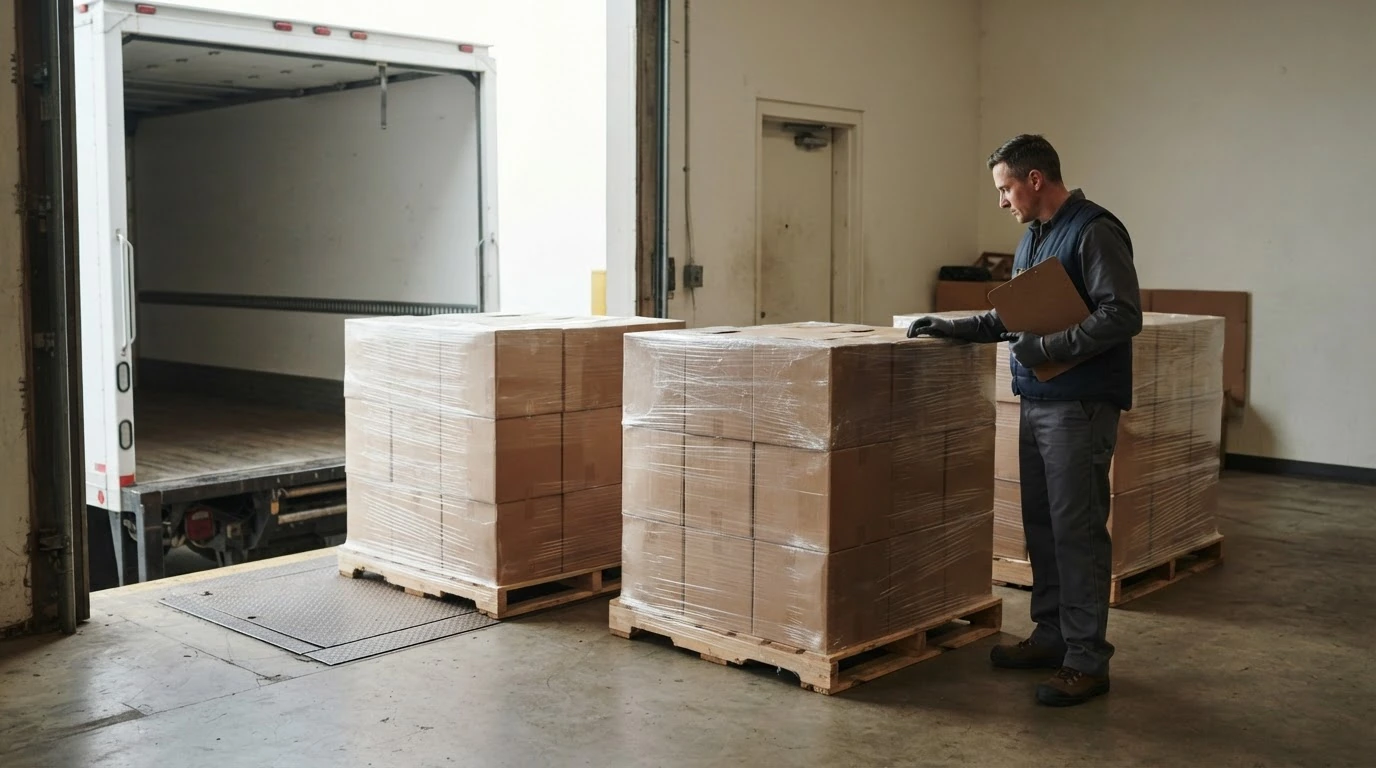
If an LTL delivery arrives with fewer handling units than the shipping documents show, count the freight again before signing. Keep the delivered freight together, confirm that every pallet, crate, drum, or carton belongs to the shipment, and write the exact shortage on the delivery receipt or electronic delivery record. A useful notation identifies what was expected and what was received, such as: 4 pallets expected; 3 received; 1 pallet short.
Take photos, keep a copy of the completed delivery record, and notify the carrier or the transportation provider managing the shipment immediately. Then open a trace for the missing freight and follow the carrier’s written claim procedure. A shortage notation is important evidence, but it is not a complete freight claim by itself.
First identify what is actually missing
The phrase “pieces are missing” can describe several different problems. The next step depends on which count is wrong.
| What you find | What it usually means | Best immediate action |
|---|---|---|
| Fewer pallets, crates, drums, or loose cartons than the delivery record shows | A visible handling-unit shortage at delivery | Recount, make a specific shortage notation before signing, photograph the freight, and notify the carrier |
| Tracking shows a part-short exception | The carrier has recorded that only part of the shipment was delivered | Ask which handling units are outstanding, request the current trace or recovery status, and still document what physically arrived |
| Every pallet arrived, but inner cartons or products are missing | A possible concealed shortage or an origin packing discrepancy | Preserve wrap, seals, labels, packing materials, and inventory records; notify the carrier and shipper promptly |
| The physical freight matches, but the BOL, packing list, or purchase order does not | A document or fulfillment mismatch may exist | Reconcile the documents before alleging an in-transit loss |
XPO, for example, defines its carrier-specific “Delivered part short” status as delivery of only a portion of the shipment, with the number of pieces short shown under exceptions. Other carriers may use different wording. Treat the tracking status as a lead, not as a substitute for the receiver’s physical count and completed delivery record.
Use this dock-side shortage checklist
1. Keep the shipment together and recount
Do not scatter the freight into storage before the count is settled. FedEx Freight’s loss-and-damage guide advises receivers to keep a shipment together until unloading is complete so it can be recounted. Check the labels on the delivered handling units to make sure they belong to the correct shipment.
Compare the physical count with the carrier’s delivery record and the bill of lading (BOL). Use the packing list to check item-level contents, but do not confuse a seller’s item count with the handling-unit count the carrier accepted.
2. Record the shortage specifically
Write the exception on the carrier’s delivery receipt or electronic device before signing. State the unit type and both counts:
[expected quantity and unit type] expected; [received quantity] received; [difference] short.
Avoid vague entries such as “short,” “possible shortage,” or “subject to inspection.” FedEx Freight says visible loss or damage should be recorded in detail and that “subject to inspection” by itself is not a valid loss-or-damage notation. UPS Supply Chain Solutions likewise tells receivers to count cargo and clearly note shortages or other irregularities on the delivery receipt or electronic device.
If the driver uses a handheld device, ask to see the recorded exception before completing the signature and obtain the delivery record through the carrier’s normal process. Do not alter a document after the handoff or ask the driver to confirm facts the driver did not observe.
3. Photograph what arrived
Take clear, time-proximate photos of:
- The complete group of delivered handling units
- The visible unit count and arrangement
- Shipping labels and the shipment or PRO identifier
- Stretch wrap, bands, seals, carton condition, and any visible openings
- The delivery receipt or electronic exception available to the receiver
Photographs do not prove every element of a claim, but they help preserve the condition and count observed at delivery. UPS’s cargo-claim guidance recommends photographs when possible and says packaging should be retained until the claim is concluded.
4. Preserve the signed record
Keep the receiver’s copy of the delivery receipt or POD. Save the BOL, packing list, purchase order, commercial invoice, shipment tracking history, photographs, and any carrier messages in one file. Record who received the freight and when the discrepancy was reported.
5. Notify the right parties immediately
Contact the carrier or the transportation provider named in the shipment workflow as soon as the shortage is confirmed. Also alert the shipper, consignee operations team, purchasing contact, and any insurer or claims administrator required by the applicable agreement.
Ask two separate questions:
- Has the missing handling unit remained at a terminal or been separated under another shipment reference?
- What notice, inspection, trace, and formal claim steps apply to this shipment?
The first question starts an operational search. The second protects the claim process. Do not assume that opening a trace automatically files a claim.
A delivery notation is not the formal claim
Federal claim-processing rules in 49 CFR 370.3 distinguish a delivery notation from a written cargo claim. Under that rule, a notation of shortage or damage on a delivery receipt, standing alone, does not meet the minimum claim-filing requirements. A written claim generally must identify the shipment, assert carrier liability, and demand a specified or determinable amount.
That distinction matters because the dock team and the claims team have different jobs:
| Dock record | Formal claim file |
|---|---|
| States the count and visible condition at delivery | Identifies the shipment and claimant |
| Is completed during the delivery handoff | States the loss and the basis for carrier liability |
| Preserves an exception while it can be observed | Requests a specified or determinable amount |
| Supports a later investigation | Includes the documents required by the carrier, contract, or tariff |
Carrier procedures and deadlines are not identical. FedEx Freight publishes service-specific guidance for shortages and claims. Estes tells receivers to record shortages on the delivery receipt, save a copy, notify the carrier promptly, and retain supporting evidence. UPS lists documents such as the BOL, commercial invoice, packing list, signed POD, inspection report, and photographs as possible cargo-claim support. Check the actual carrier’s current rules, the bill of lading, contract, tariff, and any cargo policy rather than applying another carrier’s deadline.
Handling units and inner contents are different counts
A frequent dispute begins when a document lists one wrapped pallet “said to contain” many cartons. The carrier may have accepted one externally countable handling unit rather than independently verifying every carton inside it. FedEx Freight’s guide explains this distinction using its own stretch-wrapped-skid notations and warns that item or purchase-order numbers are not necessarily counts the carrier verified at pickup.
For the shipment in front of you, review the original BOL and pickup record closely:
- What unit did the carrier sign for: pallets, cartons, crates, drums, or loose pieces?
- Did the document use a qualifier such as “said to contain” or “unable to count”?
- Was the wrap or seal intact when tendered and when delivered?
- Does the packing list describe contents that were never visible to the carrier?
- Is the shortage in the transportation count, the seller’s packing count, or the receiver’s inventory count?
Do not rewrite an inner-item shortage as a missing pallet if every pallet arrived. Accurate terminology makes the carrier trace and the commercial reconciliation more useful.
If the shortage is found after the driver leaves
Act promptly, but describe only what is known. Preserve the delivered freight and all packaging, photograph the condition, compare the BOL and packing list, and notify both the carrier and shipper. Ask whether the carrier requires an inspection or written confirmation under its current rules.
A clean delivery receipt can make a later shortage harder to establish, but it does not justify inventing a dock-side observation or changing the signed record. The investigation may need to distinguish concealed loss from an origin packing error, miscount, unit-of-measure mismatch, or later inventory movement.
If a missing handling unit is delivered later, record that second handoff separately and update the trace or claim. Do not discard the first receipt; together, the records show what arrived at each delivery.
Build a claim-ready evidence file
Before submitting anything, assemble the materials the applicable carrier requests. A practical file commonly includes:
- BOL and carrier shipment or PRO number
- Signed delivery receipt or POD with the shortage notation, if one was made
- Packing list and purchase order
- Commercial invoice or other support for the claimed value
- Photos of the freight, labels, wrap, seals, and count at delivery
- Written notice, trace number, and carrier correspondence
- A clear calculation of the quantity and value claimed
- Inspection information, if the carrier requested or waived an inspection
Keep the claim amount tied to records. Do not use the retail value, replacement cost, freight charge, or incidental business loss interchangeably without checking the governing agreement and the carrier’s required valuation support.
Prevent the next shortage from becoming ambiguous
At pickup, make the externally countable handling units clear on the BOL and labels. Give the receiver the expected pallet and piece counts before delivery. Use a receiving process that separates carrier-level handling-unit verification from item-level inventory receiving, and make sure the person signing knows how to enter a specific exception.
Shipocity is backed by a team with more than 40 years of combined logistics experience. Through established industry relationships, the platform helps businesses compare competitive freight rates for their specific shipment.
For the next shipment, prepare the actual origin, destination, packaged dimensions, weight, commodity, handling-unit count, freight class when known, and required services, then get a quote for your next shipment.