
What Is Residential Freight Delivery?
Learn how carriers define residential freight delivery and which separate services, such as liftgate, appointment, or inside delivery, the stop may require.
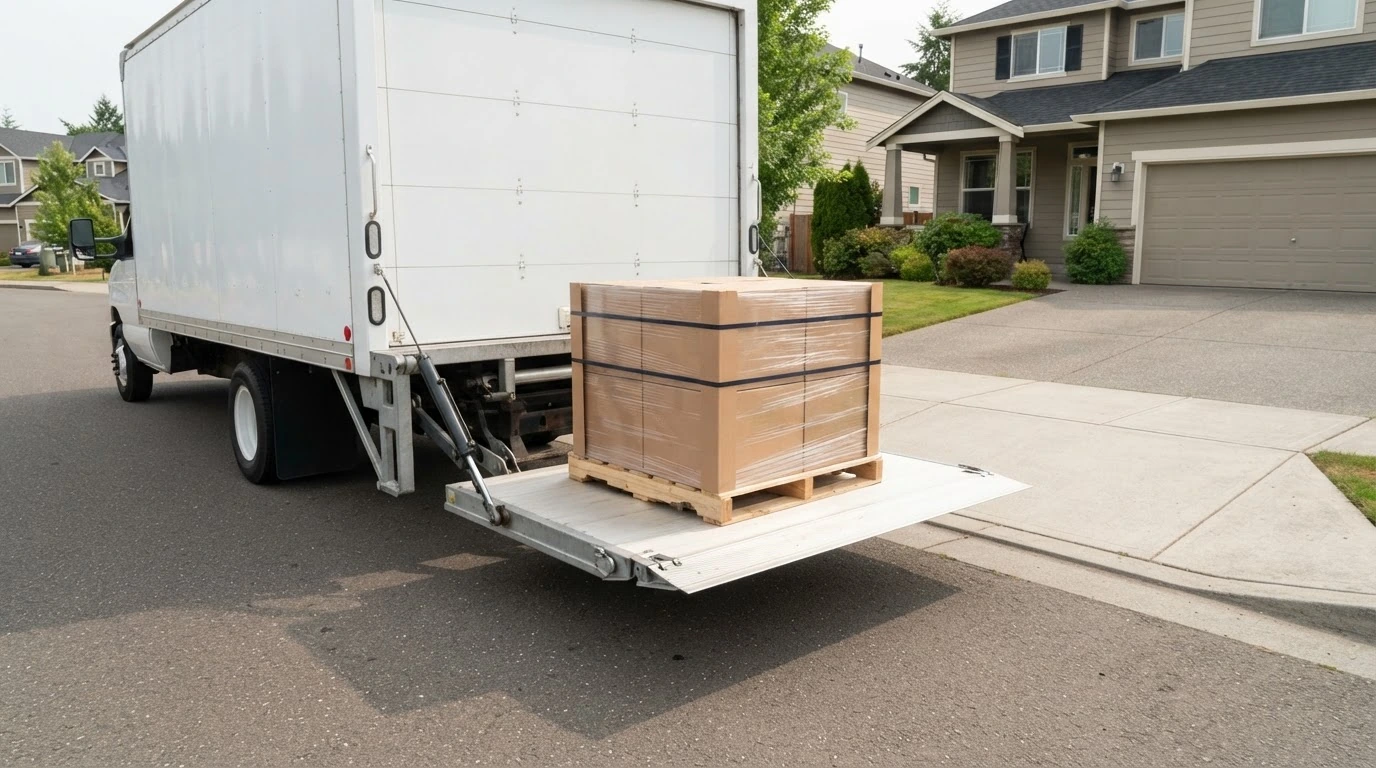
Residential freight delivery is pickup or delivery of a freight shipment at a home, apartment, estate, farm, or another location a carrier classifies as residential. It is different from a routine commercial dock delivery because the stop may require special planning, equipment, access, or handling.
The residential designation does not automatically include a liftgate, inside delivery, an appointment, or room-of-choice placement. Those may be separate services, depending on the carrier and the shipment.
What makes a freight stop residential?
The carrier’s rules control the classification. A street address that looks like a business to the shipper can still be residential under the applicable tariff if the operating location is a home or residential property.
Old Dominion’s rules, for example, address pickup or delivery at residences, apartments, boat slips, estates, and farms. ArcBest describes residential freight delivery as moving items that are too large for parcel service to a customer’s home or home-based business. These examples are useful, but they are not a universal definition for every carrier.
Do not decide from the company name alone. A business run from a house may still be a residential stop. Conversely, a commercial site without a dock is not necessarily residential; it may require a commercial non-dock or limited-access service instead.
When the classification is uncertain, give the carrier the complete address and facility type before booking.
Residential delivery is a location service, not an unloading promise
This distinction prevents many quoting mistakes.
Selecting residential delivery tells the carrier what kind of stop it must serve. It does not, by itself, answer how the freight will leave the trailer or where the driver will place it.
| Question | Service that may address it |
|---|---|
| Is the destination a home or other carrier-defined residential property? | Residential delivery |
| Is there no suitable dock or unloading equipment? | Liftgate delivery may be required |
| Must the carrier move freight beyond its standard unloading position? | Inside delivery or a specialized final-mile service may be required |
| Must the delivery occur within an arranged window? | Appointment or notification service may be required |
| Is the location difficult to access or classified separately by the carrier? | Limited-access or another location-specific service may apply |
Current carrier materials treat these as distinct choices. The FedEx Freight rate form lists residential delivery and delivery appointment separately. Old Dominion’s 2026 accessorial brochure separately lists liftgate, inside pickup or delivery, appointment notification, and limited-access service. The applicable tariff and quote determine which charges apply together.
When a liftgate may be needed
Freight trailers are designed to meet loading docks at trailer height. Most homes do not have a dock, forklift, or other equipment that can safely remove a pallet from the trailer.
A liftgate is a power-operated platform that raises or lowers freight between trailer height and ground level. FedEx advises freight customers to request one when a location has no loading dock. Estes likewise tells shippers to specify the liftgate during the pickup request or on the bill of lading so the arriving vehicle has the required equipment.
Residential and liftgate service should still be selected separately when the quote requires both. Some specialized residential products may bundle equipment or placement into a defined service level, while a conventional LTL quote may not. Confirm what the selected carrier’s rate includes.
Equipment compatibility also matters. A carrier may decline liftgate service if the handling unit cannot be moved safely on its equipment. Provide the packaged dimensions, weight, and handling-unit type rather than assuming every pallet fits every platform.
Where will the carrier leave the freight?
There is no single placement rule for every residential freight product.
A conventional LTL residential delivery, a carrier’s basic final-mile product, and a white-glove service can have different delivery boundaries. Estes currently describes its Standard Front Door residential product as placement in a covered area such as a driveway, garage, or porch, but that definition belongs to that particular service. It should not be copied onto another carrier’s standard LTL tariff.
Before booking, identify the exact service boundary in the quote or carrier guide. Ask whether delivery means:
- At the carrier’s standard unloading position
- At the curb or driveway
- In the garage or on a covered porch
- Across the first threshold
- In a chosen room
- With unpacking, assembly, or debris removal
The farther the requested placement moves beyond a basic freight handoff, the more likely it is to require a defined final-mile or white-glove service. Stairs, elevators, gravel, steep grades, narrow doors, tight turns, gates, overhead obstructions, and long carries can also change what is safe or available.
Appointments and notification are carrier-specific
The draft assumption that residential freight always requires an appointment is not reliable.
Some services schedule a delivery window. Others allow unattended delivery unless a signature or appointment is requested. Estes, for example, says its current Standard Front Door product does not require an appointment or signature, while appointment or signature requirements must be coordinated when booking.
Treat appointment, call-before-delivery, notification, and signature as separate questions. Confirm:
- Whether the carrier will contact the receiver
- Whether the contact is a notice or a scheduled appointment
- Whether a signature is required
- Whether the receiver must be present
- Whether the requested option carries a separate charge
Give the carrier a reliable receiver name and phone number. A missing or incorrect contact can prevent completion even when the address is correct.
Residential, commercial non-dock, and limited access are different
These categories describe different operating conditions and should not be used interchangeably.
- Residential: A home or another property the carrier defines as residential.
- Commercial non-dock: A business location without a dock, such as a storefront or small facility. It may need a liftgate without being residential.
- Limited access: A location the carrier identifies as requiring extra time, coordination, or restricted access. Carrier examples often include schools, construction sites, churches, military facilities, or similar stops.
A location can trigger more than one service. A residence behind a controlled gate, for example, may present both residential and access constraints. That does not mean every carrier will apply the same labels or charges. Describe the facts and let the current carrier rules determine the service combination.
What happens when residential service is omitted?
If the carrier discovers that the quoted commercial stop is actually residential, it may apply the residential charge under its tariff or pricing agreement. If the truck also lacks required unloading equipment, the delivery can require approval, rescheduling, redelivery, or a return to the terminal.
Estes specifically warns that an unplanned liftgate or inside-delivery requirement can create an additional charge and may require the shipment to return to the terminal until the right equipment or personnel are available.
The better solution is not to guess which surprise fee is most likely. It is to describe the location and select the needed services before the freight moves.
Information to gather before requesting a quote
Prepare both shipment details and stop details:
- Complete origin and destination addresses and ZIP codes
- Whether each location is residential, commercial, or another facility type
- Receiver name and working phone number
- Number and type of handling units
- Packaged length, width, height, and weight of each handling unit
- Commodity description and freight class, when known
- Dock, forklift, or other unloading-equipment availability
- Liftgate requirement at pickup, delivery, or both
- Required placement point
- Appointment, notification, and signature requirements
- Road width, gate, driveway surface, grade, overhead clearance, and turning constraints
- Stairs, elevators, door widths, or other interior constraints when additional placement is requested
Avoid adding informal directions to the legal street-address field. Give the carrier the official address, then provide delivery instructions through the designated instructions or contact process.
A practical residential-delivery decision sequence
Work through these questions in order:
- How does the carrier classify the location? Confirm residential, commercial non-dock, limited access, or another category.
- How will the freight get off the trailer? Identify a dock, forklift, receiver-provided equipment, or required liftgate.
- Where must the freight be placed? Compare the requested endpoint with the carrier’s included delivery boundary.
- Can the equipment reach and handle the stop safely? Check the road, driveway, surface, clearance, packaged size, weight, and route.
- How will the delivery be coordinated? Confirm notification, appointment, presence, and signature requirements.
- Which services appear in the actual quote? Verify that the rate reflects the answers above before booking.
This sequence applies to the real operating conditions without inventing a universal residential-delivery package.
Quote the stop you actually have
Residential freight delivery is not simply a pallet sent to a house. It is a carrier-defined location service that must be paired with the correct unloading, placement, access, and coordination choices.
Shipocity is backed by a team with more than 40 years of combined logistics experience. Through established industry relationships, the platform helps businesses compare competitive freight rates for their specific shipment.
Once you have the packaged dimensions, weight, address type, unloading equipment, access constraints, and requested placement, get a freight quote from Shipocity with the required residential and delivery services included.