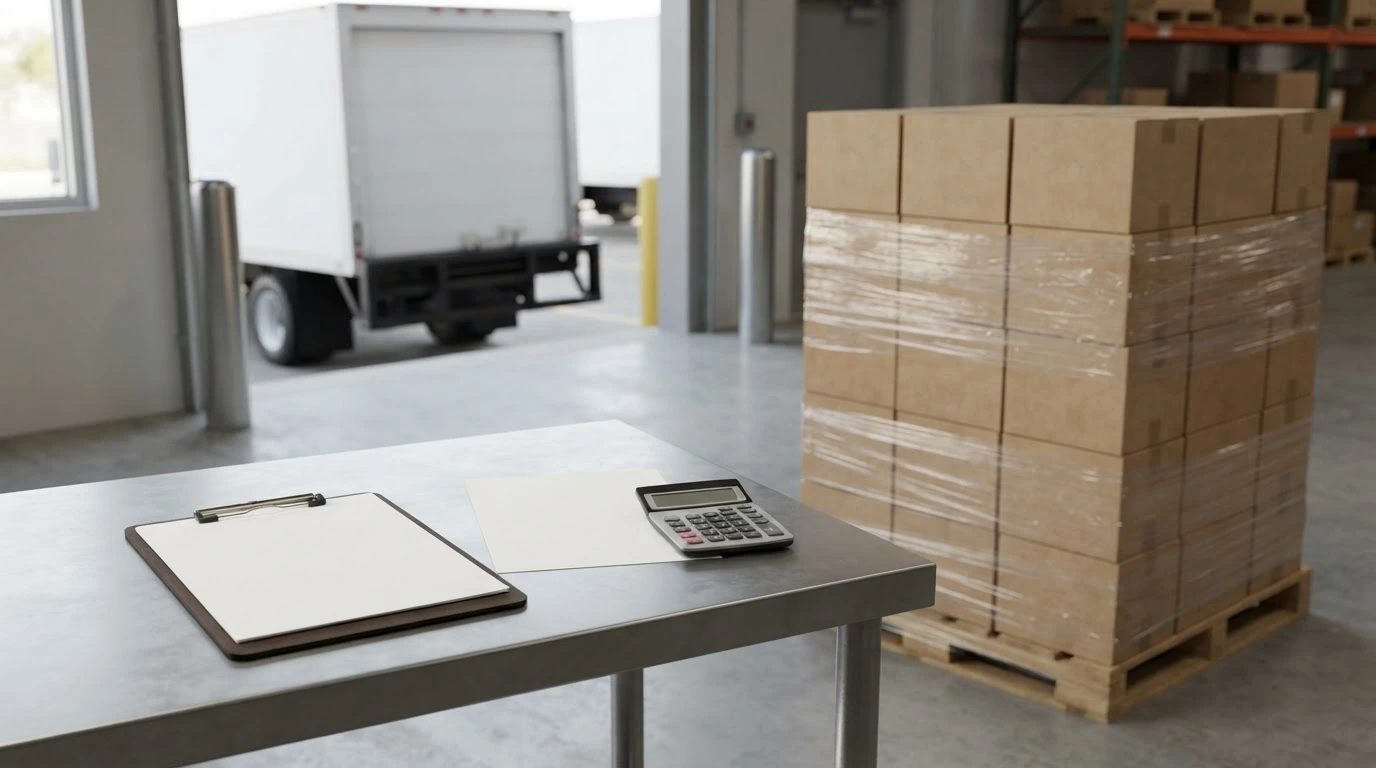
What Is Liftgate Delivery?
Liftgate delivery is a freight accessorial that uses a hydraulic platform to load or unload freight when a location has no dock. Learn when it's required and how to quote it.
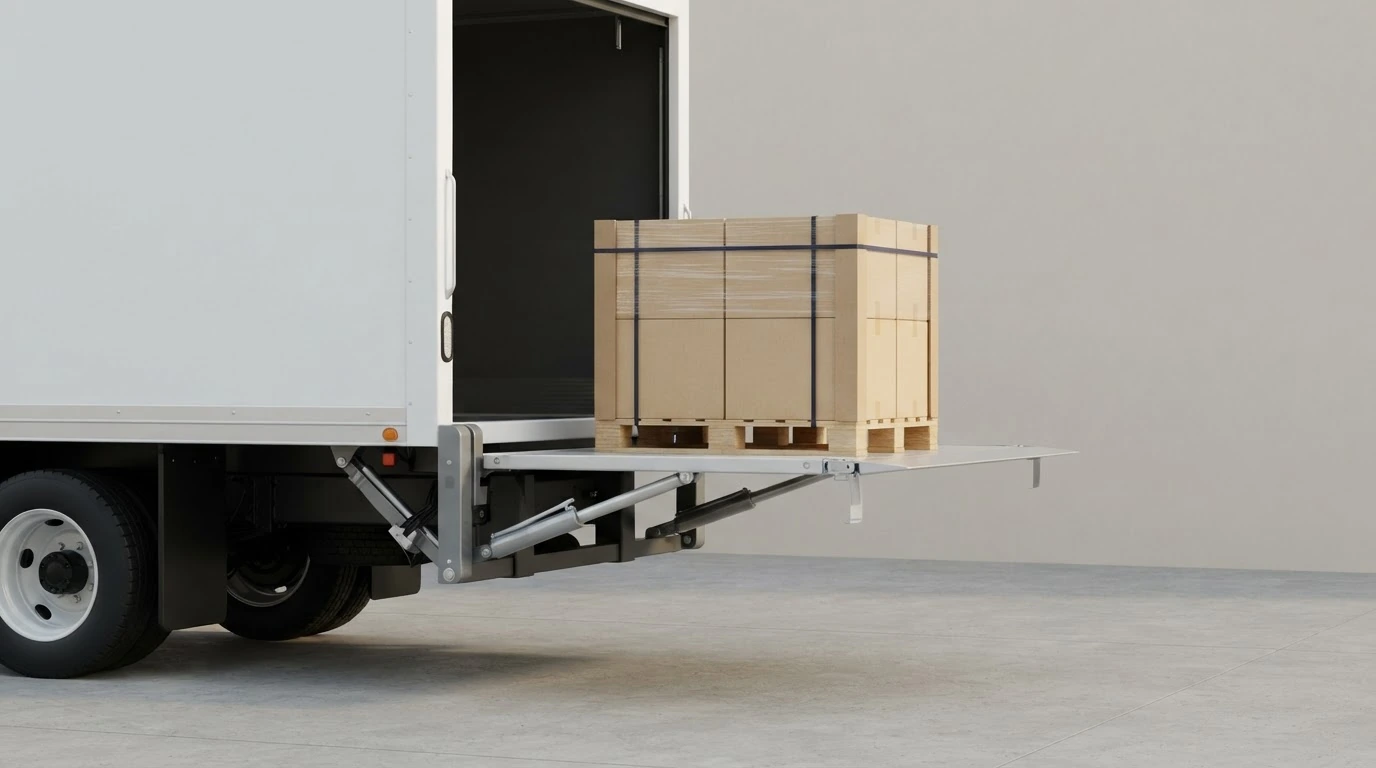
Liftgate delivery is an LTL accessorial service that uses a powered platform at the rear of a truck to move freight between trailer height and ground level. It is typically requested when a pickup or delivery location does not have a suitable loading dock or forklift for the handling unit.
The liftgate solves the vertical movement between the trailer and the ground. It does not automatically include moving the freight inside a building, unpacking it, assembling it, or placing it in a particular room. Those tasks may require a different carrier service or a separate delivery arrangement.
How a freight liftgate works
A liftgate is a metal platform connected to the truck by a hydraulic or electric-powered mechanism. The carrier positions the truck on suitable ground, deploys the platform, and raises or lowers the freight between ground level and the trailer floor.
For palletized freight, the handling sequence generally uses a pallet jack or another compatible device:
- The platform is lowered and positioned for safe loading.
- The pallet is moved onto the center of the platform.
- The freight and handling device remain within the platform’s usable area and capacity.
- The driver operates the liftgate to raise or lower the load.
- The pallet is moved between the platform and trailer, or from the platform to the carrier’s standard ground-level delivery point.
The exact procedure depends on the truck, liftgate, carrier safety rules, site, and freight. The carrier’s driver or trained personnel control the equipment. A shipper or consignee should not operate it without authorization.
When liftgate service is relevant
The first question is not whether the address is a business or a residence. It is whether the stop has equipment and access that can safely transfer the completed handling unit between the ground and trailer height.
Liftgate service may be relevant when:
- There is no raised loading dock.
- A dock exists but is not available or compatible with the truck.
- There is no suitable forklift or other authorized unloading equipment.
- The freight is palletized or too large for safe manual handling.
- The carrier requires a liftgate-equipped vehicle for the stop or shipment.
A ground-level commercial building can need a liftgate. A residence often needs one, but residential service and liftgate service are separate accessorials. A residence may trigger the carrier’s residential rule even if unloading equipment is available, while a commercial stop may need a liftgate without being residential.
Use the actual location and freight facts. A photo of the receiving area, confirmation from the consignee, or a direct carrier check can be more reliable than assumptions based on the street address.
Pickup and delivery are separate decisions
Liftgate service can apply at origin, destination, both, or neither. Check each stop independently.
If the origin can load the trailer safely but the destination cannot unload it, request delivery liftgate service. If the destination has suitable equipment but the origin does not, request it at pickup. If neither stop can transfer the freight at trailer height, both services may be needed.
Carrier tariffs may list pickup and delivery liftgate as separate applications or charges. Do not assume one liftgate selection covers both ends. Confirm how the quote identifies each stop and how the carrier applies its tariff.
For a more focused decision checklist, see when liftgate service is needed.
Liftgate delivery is not inside delivery
Liftgate delivery generally ends after the freight reaches ground level at the truck’s standard delivery point. Inside delivery addresses movement beyond that point under the carrier’s specific service definition.
The difference matters when a consignee expects the pallet to cross a threshold, travel down a hallway, use an elevator, go up stairs, or be placed in a room. Standard inside service may not cover all of those actions. White-glove, final-mile, installation, debris removal, or other specialized services can have separate rules.
Before booking, define the desired endpoint in plain language and compare it with the carrier’s current service description. “Liftgate and inside” should not be treated as a promise of room-of-choice placement unless that is explicitly part of the selected service.
Freight must fit the equipment
A dockless location does not guarantee that a liftgate can handle the shipment. The completed handling unit has to fit the equipment’s platform, capacity, balance, and operating conditions.
Confirm:
- The greatest packaged length and width of each handling unit.
- The gross weight, including pallet and packaging.
- The center of gravity and whether the load is stable on a moving platform.
- Whether a pallet jack can enter and maneuver around the pallet.
- Whether the liftgate can remain level on the available surface.
- Whether the site has enough clear space behind the truck.
FedEx’s current freight packaging guidance publishes specific platform dimensions and weight limits for its liftgate service and warns that larger or heavier freight may be rejected. Those numbers are carrier-specific and can change. Other carriers, vehicle types, and liftgate models may have different limits.
Long freight, unusually wide pallets, top-heavy equipment, rolling items, or loads with an offset center of gravity may need another unloading plan. The carrier may require prior approval, different equipment, terminal pickup, or a specialized service.
Packaging still matters on a liftgate
The load should be stable before it reaches the platform. A liftgate does not correct weak pallet construction, overhang, loose product, an unstable stack, or missing blocking and bracing.
Before pickup, verify that:
- The pallet or skid supports the full package footprint.
- The freight is secured to the base and cannot slide or rotate.
- Fork and pallet-jack openings are clear.
- Bands, stretch film, blocks, and fasteners cannot catch on the platform.
- The load does not lean, rock, leak, or change shape.
- Required labels and handling marks remain visible.
The transition onto and off the platform can introduce movement. Packaging and restraint should account for that movement without depending on a handler to steady the freight manually.
Site conditions can prevent safe service
Liftgates need suitable operating space. A steep slope, soft shoulder, loose gravel, obstruction, low overhead clearance, traffic exposure, or inadequate room behind the truck can make deployment unsafe or impractical.
Tell the carrier about access constraints before dispatch. Confirm gate codes, security procedures, receiving hours, parking restrictions, and contact information. If the carrier cannot position the truck safely, the presence of a liftgate does not guarantee completion.
The consignee should also have a plan for the freight after it reaches the ground. A pallet jack works best on a firm, level, smooth surface. It may not travel safely across grass, gravel, curbs, steps, or damaged pavement. Liftgate service should not be used to imply movement across an unsuitable surface.
Liftgate pricing varies by carrier
Liftgate is usually an additional service rather than part of a standard LTL rate. The current amount, minimum, maximum, billing unit, geographic exception, and customer-specific discount depend on the carrier’s tariff or pricing agreement.
Do not rely on a generic online fee range. Current ODFL and Estes materials show that carriers publish their own liftgate charges and rules, while customer agreements may create exceptions. The quote for the actual carrier, lane, stop, and shipment is the useful comparison.
Requesting liftgate during the quote gives the carrier the service configuration before dispatch. If the service was omitted but the actual stop requires it, the rate may change, the carrier may seek authorization, or the pickup or delivery may need to be rescheduled under that carrier’s process.
Information to gather before requesting a quote
For each stop, record:
- Whether a suitable dock is present and available.
- Whether a suitable forklift or other unloading equipment is present and authorized.
- Whether liftgate is needed at pickup, delivery, or both.
- The carrier-relevant location type, such as commercial, residential, or limited access.
- The greatest packaged dimensions and gross weight of each handling unit.
- Whether the freight is stable, pallet-jack accessible, and compatible with a liftgate.
- Receiving hours, appointment or notification needs, and a working contact.
- Any space, slope, surface, gate, or vehicle-access constraint.
Also provide the origin and destination ZIP codes, commodity description, applicable NMFC item and class when known, pallet or piece count, stackability, and any other required services. These details let the quote reflect the shipment the carrier will actually encounter.
Build the quote around the real stop conditions
Shipocity is backed by a team with more than 40 years of combined logistics experience. Through established industry relationships, the platform helps businesses compare competitive freight rates for their specific shipment.
Once both locations and the finished freight have been checked, build a quote with the required pickup and delivery services.