
Residential vs Commercial Freight Delivery
Compare residential and commercial freight delivery, then identify the unloading, access, placement, and coordination services the actual stop requires.
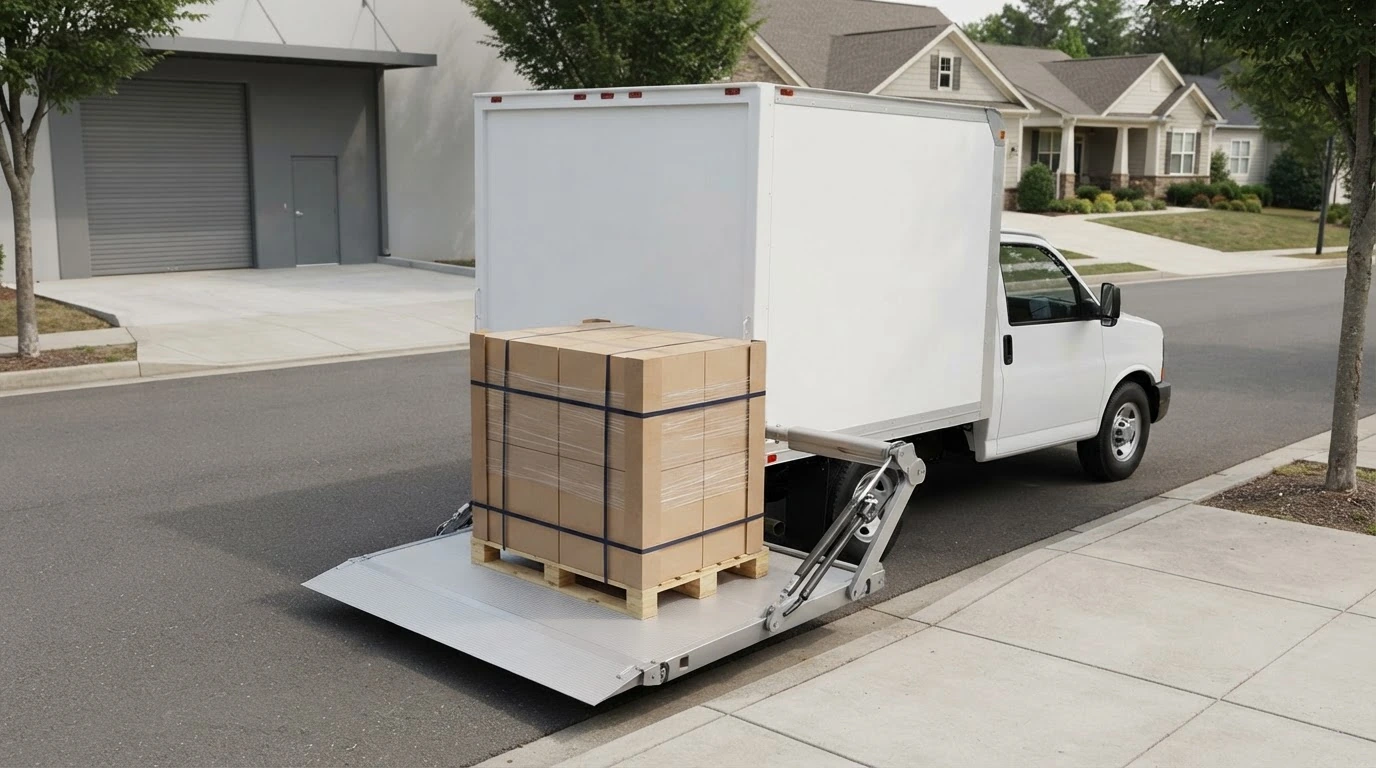
Residential and commercial freight delivery describe the type of pickup or delivery location, but the label alone does not tell you which equipment or services the shipment needs.
A residential stop is a home or another property the carrier defines as residential. A commercial stop is a business location, but a standard commercial freight rate often assumes the carrier can use a normal loading position without special equipment or extra handling. A storefront, school, farm, construction site, or business without a dock can be commercial and still require additional services.
The practical difference
| Question | Residential delivery | Commercial delivery |
|---|---|---|
| What kind of location is it? | A private residence or another location covered by the carrier’s residential rule | A business location under the carrier’s rules |
| Does the label guarantee a dock? | No | No |
| Does the label include a liftgate? | Not automatically | Not automatically |
| Does the label include inside placement? | Not automatically | Not automatically |
| Is an appointment always required? | No; this depends on the selected service | No; this depends on the selected service |
| Can other accessorials apply? | Yes | Yes |
The correct quote depends on both what the location is and what must happen at the stop.
What carriers may treat as residential
Carrier tariffs define residential service. Estes’ current rules apply its private-residence item when a consignee is located at a private residence, including a condominium or apartment. The rule applies to the premises as a whole, with a stated exception for a portion where merchandise or services are sold to walk-in customers during normal business hours.
That is more precise than the common claim that municipal zoning decides every shipment. Zoning may be useful context, but it is not a universal replacement for the carrier’s tariff. A company name at a home address does not automatically turn the stop into a routine commercial delivery.
Residential properties can also include categories such as apartments, estates, or farms under some carrier rules. Because definitions vary, give the carrier the complete address and describe the operating location honestly.
What a standard commercial freight stop assumes
“Commercial” can describe many kinds of destinations, but not every business is a standard dock stop.
ArcBest’s current managed-services terms provide one clear example of a standard LTL commercial assumption: a business in a commercial area where pickup or delivery can be performed at a trailer-height dock without specialized carrier equipment, during normal business hours, by one person, without advance arrangements. The same terms identify services such as appointment delivery, liftgate, limited access, and inside delivery as outside that baseline.
This does not create a universal rule for every carrier. It shows why checking “commercial” is not enough when the destination is a retail store, restaurant, office, storage facility, school, church, construction site, or other location without a usable freight dock.
Estes even offers a distinct commercial non-dock final-mile product for locations such as storefronts and construction sites. Commercial and dock-equipped are not synonyms.
Compare the stop in two layers
The safest way to quote either destination is to separate the location classification from the operating requirements.
Layer 1: How is the location classified?
Choose the carrier-defined location type:
- Residential
- Commercial
- Commercial non-dock
- Limited access
- Another specialized location category
Layer 2: What must the carrier do?
Then identify the required services:
- Liftgate at pickup, delivery, or both
- Inside pickup or delivery
- Appointment or prior notification
- Signature or attended delivery
- Specialized final-mile placement
- Redelivery, if the first attempt cannot be completed
Current Old Dominion materials list residential or limited-access service, liftgate, inside delivery, appointment notification, and redelivery as separate accessorial items. That structure illustrates why one location label should not be assumed to include the others.
When a liftgate is needed
A liftgate moves freight between trailer height and ground level. It may be needed at a residence because most homes lack a freight dock, but it can be equally necessary at a commercial non-dock location.
The deciding question is not “residential or commercial?” It is “Can this location safely load or unload the handling unit at trailer height?”
If the answer is no, tell the carrier what equipment is available and request a liftgate when appropriate. Provide the packaged dimensions, weight, and handling-unit type so the carrier can determine whether its equipment can handle the freight safely.
Residential service does not automatically include a liftgate in every conventional LTL quote. Commercial service does not automatically exclude one.
Delivery placement is a separate choice
Neither residential nor commercial classification guarantees room-of-choice placement.
The delivery boundary can range from the carrier’s standard loading position to a driveway, covered area, first threshold, or chosen room, depending on the selected product. Estes, for example, distinguishes its residential Final Mile service from its commercial non-dock service and defines placement within those specific products. Those service descriptions should not be applied to another carrier’s standard LTL rate.
If the receiver expects more than a basic freight handoff, describe the endpoint before booking. Ask whether the selected service covers:
- Ground-level handoff
- Driveway, garage, porch, or covered-area placement
- Front or rear commercial entrance
- Movement across a threshold
- Stairs or elevators
- Room-of-choice placement
- Unpacking, assembly, or debris removal
Inside delivery and specialized final-mile services have their own limits. Door width, turns, surface conditions, grade, stairs, elevator access, freight size, and safety conditions can affect availability.
Appointment and signature rules can differ
Residential does not always mean appointment-only. Estes’ current Standard Front Door service, for example, allows unattended delivery unless an appointment or signature has been arranged. Other services may require scheduling or notification.
Commercial deliveries can also require appointments, especially at facilities with controlled receiving hours. Treat appointment, call-before-delivery, delivery window, presence, and signature as separate requirements instead of inferring them from the address type.
Confirm who will receive the freight and provide a working contact number whenever coordination is required.
Which one costs more?
There is no reliable universal price difference you can apply without a shipment-specific quote.
Residential delivery is commonly an accessorial service, and ArcBest’s current guide notes that residential or non-commercial stops often carry additional fees because of route and time considerations. But a commercial stop can also incur liftgate, limited-access, inside-delivery, appointment, detention, or other charges.
The final comparison depends on the carrier, tariff, pricing agreement, lane, handling units, facility type, equipment, access constraints, and requested service boundary. A dock-equipped commercial stop may be simpler than a residential stop, while a difficult commercial non-dock location may need several additional services.
Compare quotes built from the same accurate shipment and stop details. Do not compare a fully configured residential quote with a commercial quote that omits equipment or access requirements.
Decision patterns without invented customer stories
| Actual stop conditions | Quote configuration to investigate |
|---|---|
| Private residence, no dock, ground-level handoff acceptable | Residential delivery plus liftgate, if not included in the selected product |
| Private residence, unloading equipment available | Residential delivery; confirm whether liftgate is unnecessary |
| Storefront or office with no dock | Commercial non-dock or applicable commercial service, plus liftgate when required |
| Warehouse with usable dock and normal receiving access | Standard commercial delivery may be appropriate |
| Business location with restricted access or controlled entry | Commercial plus the carrier’s applicable limited-access or appointment service |
| Either location requires movement beyond the standard handoff point | Add the appropriate inside or specialized final-mile service |
These are decision patterns, not promises about a particular carrier. The current tariff and quote control.
Mistakes that create adjustments or failed delivery attempts
- Calling a home-based business commercial without checking the tariff. The operating address may still fall under the residential rule.
- Treating every business as dock-equipped. Commercial non-dock service exists because many businesses cannot receive a standard trailer at dock height.
- Assuming residential includes liftgate. The location category and unloading equipment may be separate selections.
- Assuming an appointment is automatic. Notification, appointment, presence, and signature rules vary by product.
- Promising inside placement from the location label. Residential or commercial classification does not define a room-of-choice service.
- Hiding access constraints until dispatch. A narrow road, gate, steep grade, gravel surface, low clearance, tight turn, stairs, or restricted receiving window can change the service plan.
When an unplanned accessorial is discovered, the carrier may need approval, add a charge, reschedule the stop, or return the freight to a terminal until the required equipment or personnel are available.
What to gather before requesting the quote
Prepare:
- Complete origin and destination addresses and ZIP codes
- Residential, commercial, commercial non-dock, or other facility type
- Receiver name and working phone number
- Packaged dimensions and weight for each handling unit
- Commodity description and freight class, when known
- Dock, forklift, or other unloading equipment at each end
- Liftgate requirement at pickup, delivery, or both
- Exact requested placement point
- Appointment, notification, presence, and signature requirements
- Road, gate, driveway, surface, grade, overhead-clearance, and turning constraints
- Door, stair, elevator, or interior-route constraints when additional placement is requested
The accurate answer is not simply residential or commercial. It is the right location category plus every service the actual stop requires.
Build the quote around the real delivery conditions
Residential and commercial freight delivery use different carrier rules, but neither label replaces a complete description of the stop. Classify the location correctly, then address unloading, placement, access, and coordination separately.
Shipocity is backed by a team with more than 40 years of combined logistics experience. Through established industry relationships, the platform helps businesses compare competitive freight rates for their specific shipment.
Once you have the shipment measurements and stop requirements, get a freight quote from Shipocity with the correct location and accessorial services included.