LTL Freight Shipping for Manufacturers
A manufacturing-focused LTL guide covering commodity-specific packaging, classification, facility services, tender, and delivery evidence.
LTL freight can fit a manufacturer when a shipment does not require a dedicated trailer and can be safely handled within a shared terminal-and-linehaul network. The decision depends on the finished handling units, commodity, classification, packaging, lane, delivery site, timing, and carrier-specific rules rather than a universal pallet or weight cutoff.
Manufacturers should treat freight preparation as part of production quality. Identify the actual commodity, design packaging for the product and LTL handling environment, measure and weigh the completed units, disclose every required service, and carry the same facts from the quote into the bill of lading and tender. That process reduces avoidable ambiguity without promising a particular rate, class, transit time, or claim outcome.
Decide whether the shipment fits LTL
Begin with the load that will leave the facility, not a rule of thumb. Record:
- origin and destination postal codes and facility types;
- handling-unit count and whether each unit is palletized, skidded, crated, or otherwise unitized;
- greatest packaged length, width, and height of every unit;
- gross weight of every unit and the total shipment;
- commodity description, applicable NMFC item, and freight class;
- stackability and any top-load, orientation, or handling restriction;
- hazardous-material status and regulated components, when applicable;
- pickup date and receiving requirements; and
- liftgate, appointment, limited-access, inside, notification, or other services.
Then compare the available LTL option with any realistic alternative for the same freight and service need. A large, long, unusually heavy, non-stackable, high-liability, temperature-sensitive, time-critical, or specialized-equipment load may need prior approval or a different service. Carrier size, weight, acceptance, and service rules differ, so confirm the current rules for the option actually being considered.
Build packaging around the manufactured product
Manufacturing freight is not one commodity. A dense machined part, a finished instrument, a motor, a drum, and a long fabricated assembly create different concentration, abrasion, vibration, moisture, stowability, and liability risks.
Use a qualified packaging reviewer when the product, value, hazard, or failure consequence warrants it. Validate the design before repeating it at production scale.
Machined parts and dense components
Dense metal parts can place high loads on a small area. Use a base and deck that support the concentrated weight, prevent movement with suitable blocking or fixtures, protect finished surfaces and edges, and contain any approved corrosion-control materials. Do not rely on stretch wrap to restrain a heavy part that can slide or rotate.
Separate parts that could strike or abrade one another. Protect threads, shafts, ports, and precision faces with purpose-built caps, guards, partitions, or cushioning that will remain in place through handling.
Motors, pumps, and machinery assemblies
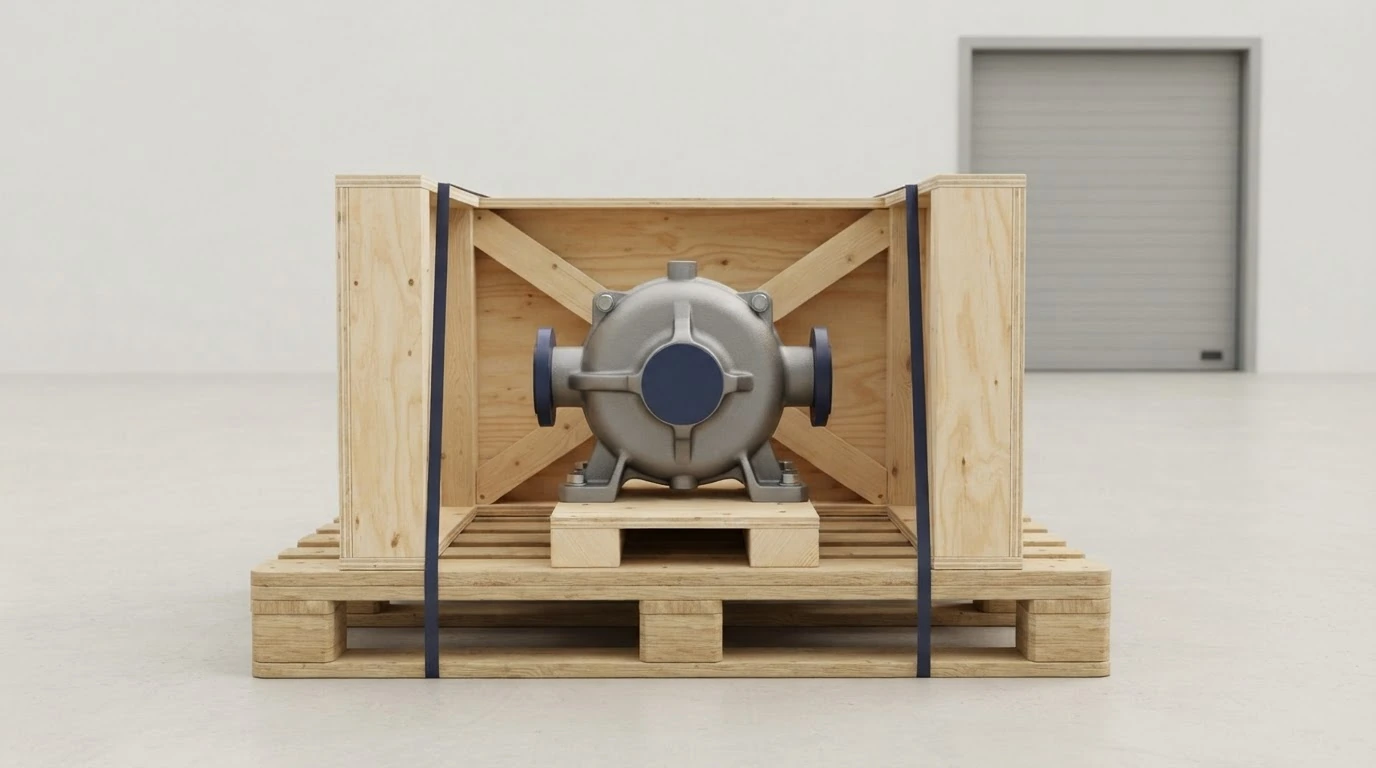
Secure the assembly to a forklift-accessible base using engineered attachment points appropriate to the product. Stabilize the center of gravity, block movement, protect protrusions, and use a crate or rigid enclosure when exposed components could be damaged or could damage other freight.
Identify batteries, fuels, oils, refrigerants, pressurized contents, or other regulated materials before tender. Draining, retaining, or packaging a fluid is product- and regulation-specific; do not assume one generic preparation step makes every machine nonhazardous.
Electronics, controls, and instruments
Use cushioning selected for the item’s mass and fragility, immobilize the product inside the container, protect connectors and displays, and consider moisture or static controls when the product requires them. A pallet can improve mechanical handling, but it does not replace the internal protection needed for shock and vibration.
Long, flat, or irregular fabrications
Use a purpose-built skid, crate, A-frame, or braced base that supports the full geometry and presents safe forklift access. Protect sharp edges and ends, prevent rolling or shifting, and include every projection in the packaged dimensions. Do not force an irregular component onto a standard pallet if doing so creates overhang or an unstable center of gravity.
Drums, pails, and process materials
Confirm container compatibility, closure, leakage control, pallet support, unitization, and segregation requirements for the actual material. FedEx’s current freight guide, for example, gives carrier-specific pallet, anti-skid, banding, edge-protection, and stretch-wrap recommendations for drums and pails. Use that guidance only when it applies, and check the governing carrier and regulatory requirements.
If the material is hazardous, PHMSA resources direct shippers to the Hazardous Materials Regulations for classification, approved packaging, marking, labeling, shipping papers, and training requirements. General freight guidance is not a substitute for a current regulatory determination.
Design for handling and stowability, not appearance
Current NMFTA guidance describes freight class through density, handling, stowability, and liability. Packaging can affect all four characteristics. A compact unit may have higher density, but classification is not a box-size shortcut; the current NMFC item, commodity description, packaging provisions, and any handling, stowability, or liability considerations still matter.
For the completed handling unit:
- keep the load within the base unless a purpose-built design requires otherwise;
- provide structurally sound forklift or pallet-jack access as applicable;
- distribute and support weight through the base;
- prevent shifting with appropriate blocking, bracing, banding, or containment;
- protect carton edges and exposed components;
- use a stable top only when the product can safely support the expected environment;
- state non-stackable or orientation restrictions truthfully; and
- remove old or conflicting labels before applying current shipment identification.
FedEx’s current freight-packing guide describes pallets, crates, blocking, bracing, load protectors, edge boards, banding, and stretch wrap as different tools with different functions. XPO’s current freight-protection resources likewise emphasize packaging performance in the LTL environment. A material should be chosen because it controls a documented risk, not because it makes the load look complete.
Measure and classify the finished units
Measure the extreme packaged dimensions, including the pallet, crate, corner protection, projections, and any device that changes the outer envelope. Weigh the complete handling unit, not the bare product. Record the measurement method and retain the result with the shipment file.
Use the current NMFC entry for the commodity as prepared. Density may be relevant, but it is not the only classification characteristic. Mixed parts or commodities should be individually and accurately described according to the rules that apply; do not assume every mixed pallet automatically takes one universal class.
Carry the same unit count, dimensions, weight, commodity, item, class, and stackability through the quote request and shipping document. If production changes the package or contents, update the shipment record before tender.
Identify facility and accessorial requirements
Manufacturers often ship between plants and distribution centers with docks, but suppliers, job sites, service depots, dealers, laboratories, farms, schools, utilities, and small customer facilities can require different handling.
Confirm at both ends:
- whether an appropriate dock or forklift is available;
- whether a liftgate is required and can handle the unit;
- whether the carrier must move freight beyond its standard pickup or delivery point;
- whether the carrier classifies the site as limited access or residential;
- whether an appointment or notification is required;
- receiving hours, closures, and contact process;
- site restrictions for vehicle size, security, or hazardous materials; and
- whether the freight requires prior approval or special equipment.
Accessorial names, definitions, limits, and charges are carrier-specific. Describe the real site and requested work during quoting instead of choosing a service from memory.
Prepare the bill of lading and tender
Use clear, specific commodity descriptions and consistent shipment data. Include the parties, handling units, weights, NMFC information and classes when applicable, hazardous-material details when required, and service instructions supported by the governing documents.
Before pickup:
- inspect the handling unit for damage, loose restraints, leaks, or instability;
- confirm labels and paperwork match the freight;
- photograph the packaged unit from useful angles for the shipment file;
- verify pickup access and equipment; and
- retain the accepted quote or pricing reference according to the carrier’s process.
The driver’s signature may acknowledge receipt without proving every concealed condition or overriding governing terms. Follow the applicable carrier rules and facility procedure.
Control delivery and condition evidence
Give the receiver the purchase-order or shipment reference, expected handling units, and inspection instructions. At delivery, compare the unit count and visible condition before signing. Record exceptions specifically on the delivery receipt when appropriate, preserve photographs and packaging, and follow the governing claim-notice and filing requirements.
Do not promise that one packaging design, notation, or photograph guarantees claim payment. Carrier liability, packaging adequacy, evidence, contract terms, and applicable law can affect an outcome. The operational goal is a truthful, traceable record.
Worked manufacturing examples without invented rates
Repeating machined-part order
A manufacturer ships dense finished housings to the same commercial receiver. The first proposed pack leaves each housing loose in a large carton on a light pallet. The revised design uses a base rated for the concentrated load, fixtures that prevent movement, protected machined faces, a rigid enclosure, and accurate completed dimensions and weight.
The manufacturer should validate protection, confirm the current NMFC item and carrier acceptance, and quote the actual revised unit. If the billed or damage result improves, record the cause without claiming the same outcome for another part or lane.
One-off control cabinet
A control cabinet has a high center of gravity and vulnerable doors, instruments, and cable entries. The manufacturer uses engineered mounting points, a stable forklift-accessible base, protection for the face and connectors, and a rigid enclosure. The shipment is marked non-stackable only if the packaged unit truly cannot support top loading, and that status is disclosed during quoting.
The two examples require different packaging because the products present different risks. Neither example supplies a class, rate, transit estimate, savings amount, or carrier recommendation.
Manufacturing LTL checklist
- Final origin, destination, and facility types
- Pickup date and receiving hours
- Exact commodity and contents of every handling unit
- Current NMFC item and freight class when applicable
- Extreme packaged dimensions and gross weight per unit
- Sound pallet, skid, or crate with suitable mechanical access
- Product-specific blocking, bracing, cushioning, edge, surface, and moisture protection
- Truthful stackability, orientation, and handling restrictions
- Hazardous-material determination and compliant preparation when applicable
- Liftgate, appointment, limited-access, inside, notification, or other required services
- Consistent quote, bill of lading, labels, and tender data
- Pickup and delivery condition documentation
Price the actual manufactured shipment
Shipocity is backed by a team with more than 40 years of combined logistics experience. Through established industry relationships, the platform helps businesses compare competitive freight rates for their specific shipment.
With the completed packaging, measurements, commodity details, and required services ready, price this type of shipment.