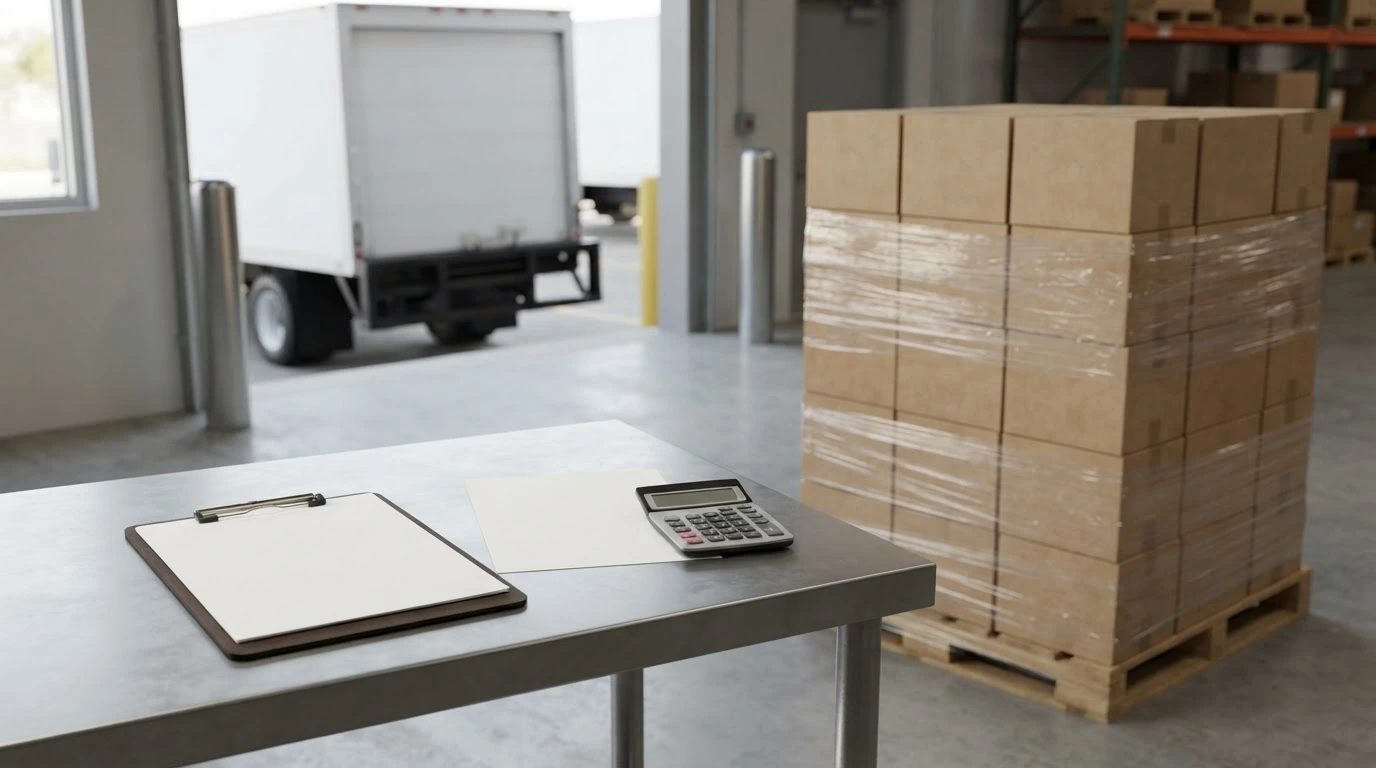
How to Weigh Palletized Freight Accurately
Practical steps to weigh a loaded pallet on a calibrated scale, what to include in the shipment weight, how weight drives density and class, and what to gather for your freight quote.
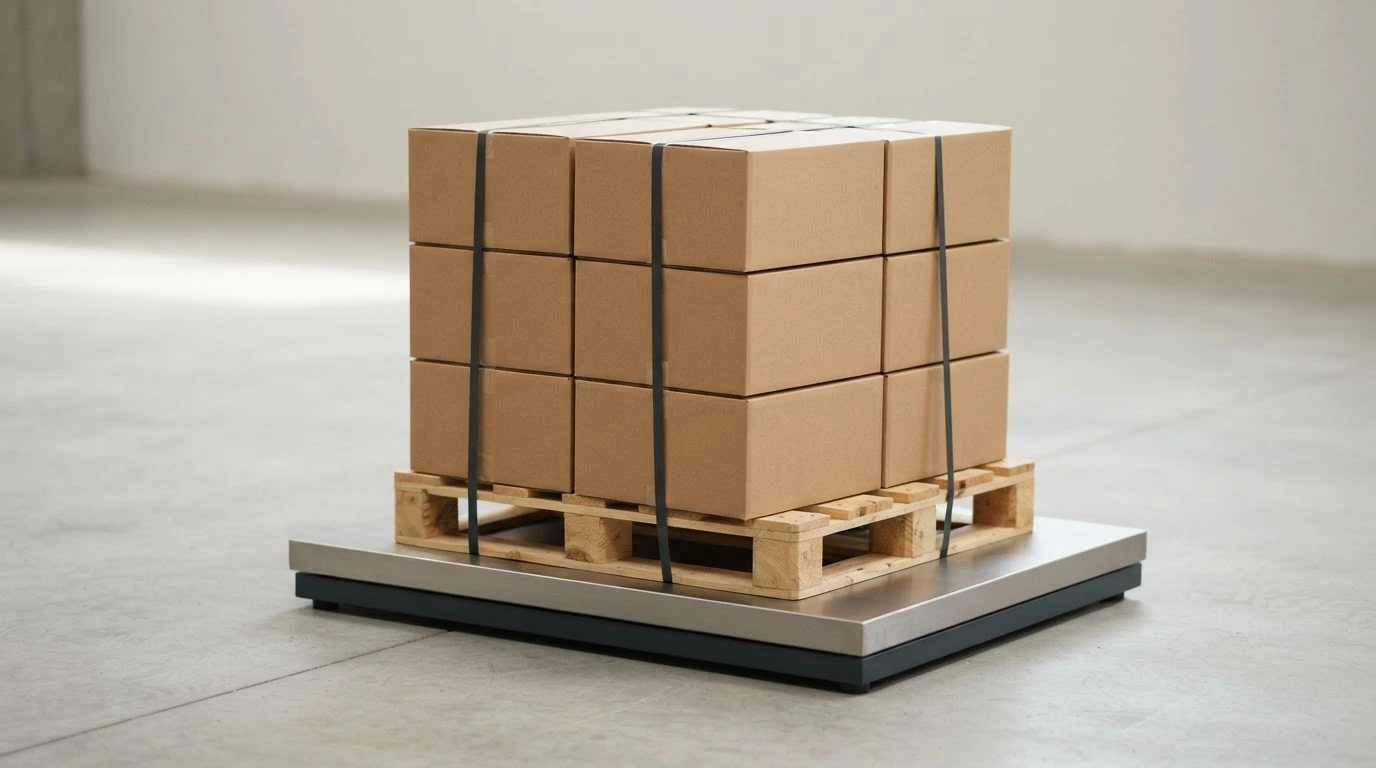
Weigh the complete, ready-to-ship handling unit on a scale suited to the load. Record the gross weight after the reading stabilizes. Gross weight includes the product, pallet, cartons or crate, dunnage, blocking, bracing, film, bands, and every other packaging component that will travel with the freight.
Do not substitute product weight or a generic pallet allowance for the finished weight when an accurate scale reading is available. If no suitable scale is available, build a documented estimate for planning and arrange verification before tendering the shipment.
What belongs in gross pallet weight
Include:
- Product
- Pallet, skid, or other handling base
- Cartons, crate, drums, bags, or other containers
- Dunnage and cushioning
- Blocking and bracing
- Stretch film, bands, and straps
- Edge protection and top cap
- Any attached hardware or protective material
The pallet’s tare weight is part of the shipment. So is a crate built around the product. Weighing before the final band, brace, or top cap is added leaves part of the handling unit out of the declared weight.
Choose a scale that fits the load
Common options include:
- Floor or pallet scale: a fixed platform for placing the complete unit
- Pallet-jack scale: a pallet jack with integrated weighing capability
- Forklift scale: a weighing system integrated with or mounted on compatible lift equipment
- Dimensioner with a scale: a system that captures dimensions and weight in the same workflow
- Certified public or carrier scale: an outside option when the shipper does not have suitable equipment
No equipment type is automatically the most accurate for every operation. The correct choice depends on capacity, minimum load, resolution, installation, maintenance, environment, and the intended commercial use.
NIST advises that the maximum expected load must not exceed the scale’s capacity and that its accuracy class must suit the application. NIST also notes that scales used in commercial applications are governed by state law and generally require inspection and approval by the authorized state body. If the recorded weight will be used to establish a transportation charge, confirm the requirements that apply where the scale is used.
Step-by-step weighing procedure
1. Finish the package
Complete the pallet exactly as it will be tendered. Secure the freight, attach the final protection, and remove tools or temporary materials that will not travel with it.
2. Confirm scale suitability
Check the scale’s capacity and operating instructions. The expected gross weight must remain within the rated range. Use the scale on the surface and in the environment specified by its manufacturer.
3. Inspect and zero the scale
Make sure the platform is clear and the displayed reading returns to zero according to the operating procedure. If the device shows an error, is overdue for required service, or has visible damage, do not treat the reading as verified.
Zeroing is not the same as calibrating. Calibration, testing, sealing, and inspection should be performed under the procedures that apply to the particular device and jurisdiction.
4. Place the entire unit on the load receiver
Center and fully support the pallet as the scale instructions require. Nothing should touch the floor, wall, rack, forklift, or another object in a way that carries part of the load. A pallet resting partly off the platform can produce an invalid reading and create a handling hazard.
5. Let the reading stabilize
Stop movement and wait for the scale’s stable indication. Record the value, unit, date, and pallet identifier. A photograph of the display and handling unit can support internal records when company policy permits, but it does not replace required scale documentation.
6. Recheck questionable results
If the reading fluctuates, differs materially from the expected total, or appears inconsistent with similar units, inspect the setup before accepting it. Check for external contact, an unstable load, an incorrect unit setting, or a scale error. Do not simply choose the lowest displayed value.
7. Weigh distinct pallets separately
When handling units differ in product, packaging, or load distribution, record each gross weight. For truly identical units, follow the quote and bill-of-lading requirements for reporting counts and weights. Avoid hiding one unusually heavy pallet inside an average.
Gross, net, and tare weight
These terms describe different values:
- Gross weight: the complete palletized handling unit
- Net weight: the product without the pallet and packaging
- Tare weight: the empty pallet and packaging deducted from gross weight to derive net weight
For a freight quote, gross handling-unit weight is the relevant shipment input. Net and tare can still be useful for inventory or production records.
If a scale’s tare function is used, follow the device instructions and applicable rules. For the clearest freight record, a direct gross reading of the completed unit avoids relying on an estimated pallet tare.
What to do when no pallet scale is available
An estimate can support early planning, but it should be traceable:
- Use documented product weights for the exact items and quantities.
- Use the actual pallet model’s tare weight or weigh an identical empty base.
- Add documented weights for the crate, cartons, dunnage, bands, bracing, and other packaging.
- Keep the calculation with the shipment record.
- Replace the estimate with a verified gross weight before final tender whenever possible.
Do not add an arbitrary percentage or generic 50-pound pallet allowance and present the result as measured. Wood moisture, construction, repairs, pallet type, and packaging can make a category-wide estimate wrong in either direction.
If the finished unit cannot be weighed locally, ask the carrier or logistics provider what verification options are available before booking. Do not assume a terminal reweigh will occur or that it will be free.
How weight affects density and classification
For a rectangular handling unit measured in inches:
Density = gross weight in pounds x 1,728 / (length x width x height)
NMFTA defines the cube from the greatest straight-line dimensions, including projections, as the unit is tendered. The gross weight used in the density calculation must describe that same finished handling unit.
Accurate weight can change density, but it does not automatically change freight class. NMFTA identifies density, handling, stowability, and liability as the four classification criteria. The applicable NMFC item, subprovision, commodity description, and packaging requirements also matter.
Do not ask a quote form to solve an uncertain classification by weight alone. When the NMFC item or class is unknown, verify it with an authoritative classification source or qualified freight professional.
Carriers may verify weight and dimensions
Current NMFTA Item 250100 guidance confirms the carrier’s right to verify shipment weight and dimensions. If verified data differs from the quote or shipping document, the applicable carrier rules and pricing determine how the shipment is rated or billed.
That is different from saying every discrepancy creates the same fee, class change, refusal, or delay. Outcomes vary by carrier, service, contract, commodity, and size of the discrepancy. The sound practice is to submit the most accurate finished weight available.
Old Dominion Freight Line’s current data-accuracy guidance recommends basic tools such as certified scales, tape measures, and training. It also notes that dimensioning systems can combine measurements and scale data for higher-volume operations. Automation can improve consistency, but it still requires suitable, maintained equipment and a controlled process.
Common weighing mistakes
- Weighing product before palletization and forgetting the base and packaging
- Using a generic pallet tare instead of the actual pallet
- Adding an arbitrary buffer to the declared weight
- Weighing before final blocking, bracing, or securement
- Exceeding the scale’s rated capacity
- Allowing part of the load to remain supported by the floor, forklift, or another object
- Recording kilograms as pounds or pounds as kilograms
- Reusing a prior weight after the product count or packaging changed
- Averaging nonidentical pallets without preserving individual weights
- Treating zeroing as proof that a scale is calibrated and approved
Quote preparation checklist
Have these details ready:
- Gross weight of each finished handling unit
- Finished length, width, and height of each unit
- Pallet or handling-unit count
- Specific commodity description
- NMFC item and freight class when known
- Stackability and special handling needs
- Origin and destination ZIP codes
- Pickup date
- Dock, forklift, pallet-jack, and liftgate availability
- Residential, limited-access, inside, appointment, hazardous-material, or other requested services when applicable
Shipocity is backed by a team with more than 40 years of combined logistics experience. Through established industry relationships, the platform helps businesses compare competitive freight rates for their specific shipment.
With the verified gross weight and finished dimensions ready, get a freight quote and create your Shipocity account.
Sources
- Weighing and Scales FAQs - National Institute of Standards and Technology
- How LTL Shipping Data Accuracy Impacts Pricing and Re-Rating - Old Dominion Freight Line
- How Is the Density of a Handling Unit Calculated? - NMFTA
- NMFC Changes FAQ: Updates to Item 250100 - NMFTA
- Classification FAQ: What Factors Determine NMFC Codes? - NMFTA