How to Ship Trade Show Freight
Plan trade show freight from the exhibitor manual: receiving path, reusable packaging, labels, carrier timing, material handling, and outbound recovery.
To ship trade show freight, start with the current exhibitor manual for the specific event. Choose the permitted receiving path, work backward from its target date or appointment, package every handling unit for repeated moves, label and document each unit exactly as instructed, give the carrier the event-specific check-in details, and arrange the outbound shipment before the show opens.
Trade show freight is not just an ordinary LTL shipment with a booth number added. Carrier transportation, an advance warehouse, venue receiving, marshaling, on-site material handling, empty-container storage, and outbound release can be separate activities controlled by different parties. Their names, deadlines, forms, service scopes, and charges vary by show.
Step 1: Build the plan from the exhibitor manual
Obtain the latest exhibitor manual or service kit from the organizer or official service provider. Do not rely on instructions from a prior year, another venue, or a general trade show article.
Extract the details that affect transportation:
- official show name, venue, hall, exhibitor name, and booth number;
- advance-warehouse and direct-to-site addresses, if both are offered;
- accepted delivery dates, target times, appointments, and closures;
- required label format and handling-unit identification;
- carrier check-in, marshaling, dock, vehicle, and driver instructions;
- material-handling order forms and payment or account requirements;
- rules for mixed, loose, uncrated, small-package, hazardous, or oversized freight;
- empty-container procedures during the event;
- move-out schedule, outbound documentation, and carrier check-in deadline; and
- contacts for inbound, on-site, and outbound exceptions.
The manual may distinguish target dates from final acceptance cutoffs or apply different terms to different freight types. Record the exact event language rather than reducing it to one generic deadline.
Step 2: Separate transportation from material handling
The LTL carrier generally transports the shipment to or from the receiving point named in the shipping instructions. The event’s on-site material-handling process may cover unloading, delivery to the booth, movement or storage of empty containers, and return of freight to the loading area after the show. The actual scope depends on the event and service order.
This distinction matters because a carrier freight quote does not necessarily include venue material handling, storage, labor, electrical service, installation, dismantling, or outbound release. Likewise, paying the venue’s material-handling charge does not necessarily arrange line-haul transportation.
GES’s current exhibitor guidance describes inbound shipping, material handling, and outbound shipping as connected but distinct parts of the trade show process. XPO and Old Dominion offer carrier-specific trade show services, but their features, service levels, geographic coverage, storage terms, guarantees, and operating procedures should be evaluated only for the shipment being considered.
Ask every provider to identify its start and end point in plain language. Clarify who is responsible for the freight at each handoff and which reference number or document connects the stages.
Step 3: Choose advance warehouse or direct-to-site receiving
When an event offers both paths, compare them against the exhibitor’s actual schedule and freight.
Advance warehouse
An advance warehouse can provide more time between delivery and booth setup because freight arrives before the event’s direct receiving window. The service provider later moves accepted freight according to the event process. Confirm the warehouse acceptance period, address, target date, prohibited or restricted freight, storage treatment, label format, and material-handling terms.
Do not assume advance delivery is automatically less expensive or that every commodity can be accepted. Compare the combined carrier, warehouse, material-handling, storage, timing, and risk implications under the current manual.
Direct to show site
Direct receiving can avoid the advance-warehouse leg but usually depends on a narrower event schedule and site process. Confirm the correct entrance or check-in point, target date and time, appointment requirements, marshaling instructions, driver contact process, unloading rules, and what happens if the truck arrives early, late, or outside the accepted window.
A normal carrier transit estimate is not a venue appointment. Build time for terminal movement, check-in, queuing, and exception recovery, and choose any time-critical service only after reviewing its governing terms.
Step 4: Inventory the exhibit by handling unit
Create one shipment inventory before packing. Include:
- exhibit structures, counters, furniture, lighting, graphics, flooring, literature, tools, and product samples;
- case, crate, carton, pallet, and loose-piece counts;
- asset or serial identifiers when useful;
- replacement priority and whether a missing item prevents setup;
- batteries, aerosols, chemicals, compressed gas, magnets, liquids, or other possibly regulated materials; and
- which items must return, go to another show, go to storage, or be discarded under an approved plan.
Avoid mixing unlike commodities in one case simply for convenience when the result is difficult to classify, protect, inventory, or inspect. If a demonstration product has regulated components, complete a current transportation determination. Event approval does not replace carrier or regulatory requirements.
Identify a minimum-show kit that can travel separately when appropriate, but do not claim that splitting freight always reduces risk or cost. Multiple deliveries can create separate receiving events or handling charges under some programs.
Step 5: Package for repeated handling and reuse
Trade show freight can move through a carrier network, receiving dock, show floor, booth setup, empty-container storage, dismantling, and outbound loading. Packaging should tolerate the planned cycle and remain usable for the return move.
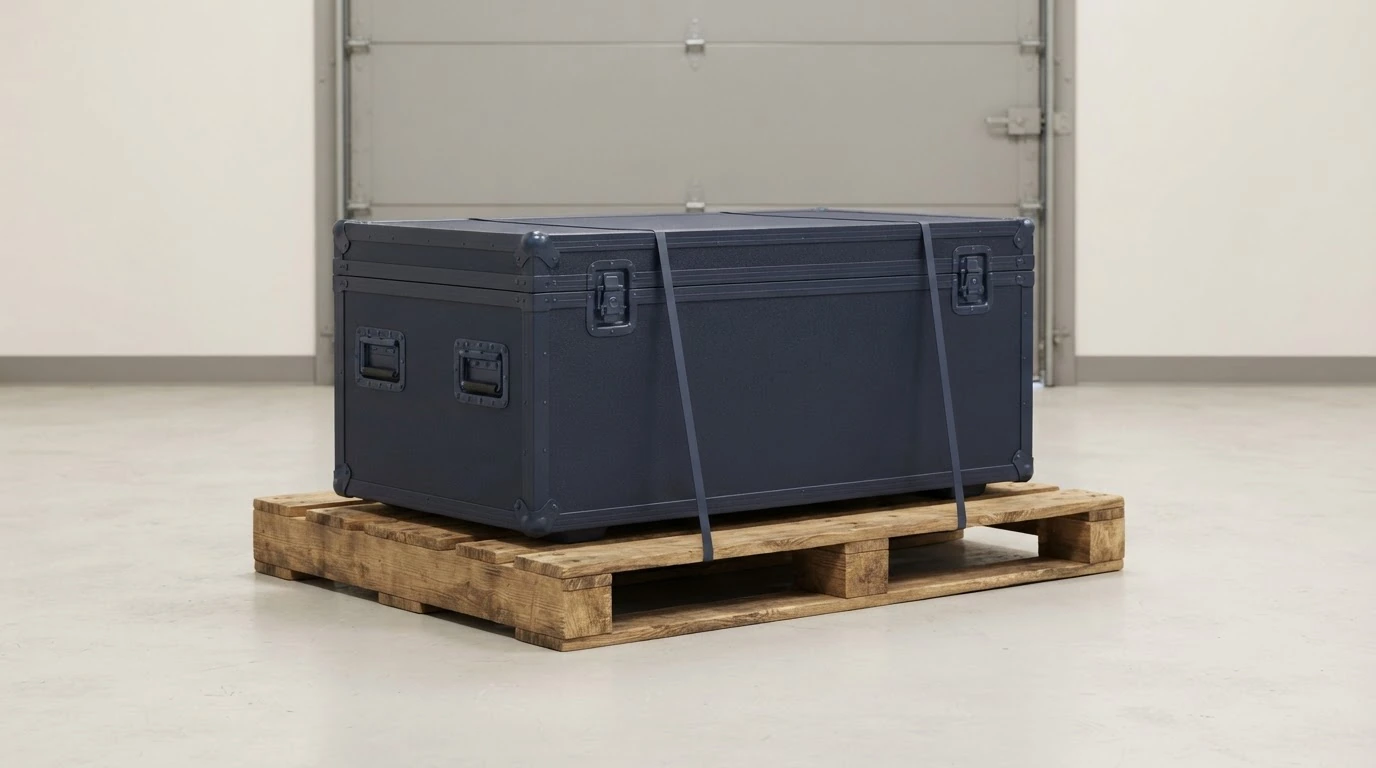
Reusable exhibit cases and crates should have sound bases, panels, closures, handles, wheels, skids, and fork access appropriate to their design. Immobilize modular frames, panels, monitors, lighting, and hardware in fitted compartments. Keep heavy items low, separate surfaces that can abrade, protect corners and connectors, and retain a packing diagram or compartment list inside the shipment records.
For palletized cartons or crates:
- use a sound base that supports the complete load;
- keep the freight within the base footprint;
- prevent shifting with appropriate blocking, bracing, banding, or containment;
- use edge protection where restraint could cut or crush packaging;
- protect graphics and finished surfaces from abrasion and puncture;
- disclose top-load and orientation restrictions truthfully;
- keep current labels visible on the outside; and
- remove or cover old show, booth, address, routing, and carrier labels.
FedEx’s current freight-packing guide distinguishes pallets, crates, blocking, bracing, edge protection, banding, and stretch wrap because they perform different functions. Stretch film alone is not adequate restraint for a heavy road case, display counter, or equipment crate.
Photograph the contents and closed package before pickup. Retain the packing list so the same items can be returned to their fitted positions after dismantling.
Step 6: Measure, weigh, describe, and classify the finished freight
Measure the extreme outer length, width, and height of every finished handling unit, including pallets, casters, lids, corner guards, runners, and projections. Weigh each complete unit rather than adding product estimates. Record unit and piece counts consistently.
Describe the actual commodities and packaging. “Trade show materials” may not be precise enough to identify the applicable NMFC treatment for mixed exhibit cases, display structures, furniture, electronics, samples, or machinery.
NMFTA describes classification through density, handling, stowability, and liability characteristics. Density may be relevant, but there is no single trade show freight class. Review the current NMFC items, notes, packaging provisions, and classes for the actual contents and prepared units. Ask a qualified reviewer when mixed commodities or unusual cases create uncertainty.
Carry the same counts, dimensions, weights, commodity descriptions, NMFC information, classes, and stackability from the quote into the required carrier and event documents. Update every affected record if the packing plan changes.
Step 7: Label and document every handling unit
Use the event’s current label template when one is supplied. Apply the required number of labels in the required locations without covering closures, fork openings, handles, or critical warnings. Each unit should be individually identifiable so one missing case can be described precisely.
Depending on the event instructions, labels may require the receiving address, event name, exhibitor, booth number, carrier, target information, and handling-unit sequence. Do not invent a universal label; follow the manual.
Prepare the carrier’s required shipping document with accurate parties, addresses, contacts, unit and piece counts, package types, dimensions, weights, commodities, NMFC information and classes when applicable, regulated-material details when required, and requested services. Keep copies available to the shipper, carrier contact, and on-site lead as appropriate.
The event may also require an inbound delivery record, material-handling order, outbound material-handling agreement, or other provider-specific form. A carrier bill of lading does not automatically replace those documents.
Step 8: Quote the complete inbound service
Give the quoting provider more than two postal codes. Include:
- event name and booth number;
- selected advance-warehouse or direct-to-site address;
- requested pickup date and required receiving window;
- complete handling-unit data and commodity descriptions;
- current event labels and check-in instructions;
- marshaling or appointment requirements;
- limited-access, liftgate, notification, inside, waiting-time, after-hours, or other known service needs;
- declared handling restrictions and prior-approval status; and
- the on-site and exception contacts.
Ask whether the quote includes the exact service and timing requested, how estimated transit differs from guaranteed service, what tracking or trade show coordination is available, and which carrier tariff or contract governs waiting time, redelivery, storage, or failed delivery.
Do not infer a rate, guarantee, complimentary storage period, or nationwide capability from a general service page. Confirm the current terms for the carrier, lane, event, and dates.
Step 9: Prepare the outbound move before the show opens
Outbound freight is a new movement, not an automatic reversal of the inbound shipment. Decide where every unit goes after the show and arrange the carrier, pickup reference, labels, documents, and event material-handling steps in advance.
Confirm:
- move-out and carrier check-in schedule;
- where and when empty cases or crates will be returned;
- who will repack and verify the inventory;
- the outbound destination and contact;
- required outbound labels and provider forms;
- carrier name, account or reference, and driver instructions;
- what release or payment conditions apply; and
- the event’s procedure if the planned carrier does not check in on time.
After dismantling, inspect cases and crates before reuse, return items to their fitted positions, remove inbound labels, apply outbound labels, photograph the closed units, and reconcile counts. Keep the on-site lead reachable until the service provider accepts the completed outbound documents under the event process.
Step 10: Document exceptions at every handoff
Use a single inventory to compare unit counts and visible condition at origin pickup, warehouse or venue receiving when records are available, booth delivery, dismantling, and outbound receipt. Record a missing or damaged unit by its unique identifier, not as a vague “booth shortage.”
If loss or damage appears, follow the current carrier and event-provider procedures for receipts, notices, photographs, retained packaging, inspection, and claims. Responsibility and liability can differ by stage and governing terms. Good records support an investigation but do not guarantee payment.
Two trade show examples without invented rates
Modular booth cases sent to an advance warehouse
An exhibitor has two fitted road cases for structural frames and panels plus one palletized carton group for literature. The team uses the current advance-warehouse address and label templates, records every unit’s dimensions, weight, contents, and sequence, confirms the acceptance period, and quotes the carrier movement separately from the event’s material-handling order. The outbound carrier and next destination are arranged before the cases leave origin.
Demonstration equipment sent direct to site
A crated demonstration machine must arrive during a target window and contains a battery that requires a current transportation determination. The exhibitor confirms direct-site instructions, marshaling and check-in procedures, carrier acceptance, package classification, venue handling, and outbound documentation. The quote uses the completed crate and real timing requirements without inventing a class, rate, guaranteed arrival, or storage allowance.
Trade show freight checklist
- Current exhibitor manual or service kit
- Official event, exhibitor, booth, and contact information
- Selected receiving path and exact address
- Target dates, appointments, closures, and check-in instructions
- Complete inventory and handling-unit sequence
- Reusable packaging suitable for the planned handling cycle
- Extreme packaged dimensions and gross weight per unit
- Specific commodities, current NMFC information, and classes when applicable
- Current regulated-material determination when applicable
- Required labels on every unit and old labels removed
- Carrier documents and event-provider forms kept distinct and complete
- Inbound transportation and material handling both confirmed
- Outbound carrier, destination, labels, documents, and fallback procedure arranged
- Condition photographs and count checks at available handoffs
Shipocity is backed by a team with more than 40 years of combined logistics experience. Through established industry relationships, the platform helps businesses compare competitive freight rates for their specific shipment.