How to Ship Building Materials by LTL Freight
Prepare building materials for LTL using form-specific packaging, finished measurements, current classification, regulated-product checks, and site details.
To ship building materials by LTL freight, identify the exact commodity and condition, build a stable forkliftable handling unit for its physical form, protect surfaces and edges, determine any hazardous-material status, measure and weigh the finished package, confirm the current classification, and disclose the actual pickup and jobsite requirements.
LTL can fit a shipment that can move safely through the selected carrier’s shared handling environment without a dedicated trailer. It is not automatically the right choice for every pallet of tile, bagged compound, sheet product, bundle of pipe, insulation load, window, door, stone piece, or metal component. Finished size, weight concentration, length, stackability, handling method, site access, and carrier acceptance determine the practical option.
Step 1: Define the actual building material
“Building materials” is too broad for a quote, shipping document, classification decision, or package design. Record:
- precise commodity, grade, form, and quantity;
- rigid, flexible, bagged, boxed, bundled, coiled, sheeted, crated, or loose-piece form;
- individual item and completed handling-unit weights;
- susceptibility to moisture, puncture, crushing, abrasion, chipping, bending, rolling, or contamination;
- sharp edges, protrusions, fragile faces, finished surfaces, or irregular geometry;
- hazardous-material or regulated-product status;
- approved lifting, fork-entry, support, and securement points;
- whether the completed unit can safely support freight above it; and
- origin, destination, receiver, and unloading requirements.
Also distinguish new saleable material from returned, damaged, wet, leaking, partially used, or waste material. Condition can change packaging, acceptance, handling, and regulatory requirements.
If the load is unusually long, tall, dense, top-heavy, non-stackable, crane-dependent, or difficult to protect in an enclosed shared network, compare LTL with a realistic alternative. Do not rely on a universal pallet-count or shipment-weight threshold.
Step 2: Check for regulated contents
Some construction products can contain materials regulated in transportation, including certain adhesives, coatings, solvents, aerosols, compressed gases, batteries, and other chemical products. A familiar trade name or retail package does not resolve the transportation classification.
PHMSA’s Check the Box program explains that common products may be hazardous materials and introduces shipper responsibilities for classification, packaging, marks, labels, documentation, and training (PHMSA: Check the Box Brochure).
Before tender:
- Obtain current manufacturer and safety information.
- Determine the proper shipping description, hazard class, identification number, packing group when applicable, and any exception under current regulations.
- Use authorized packaging and complete required marks, labels, documents, emergency information, and training.
- Confirm carrier and service acceptance for the material as prepared.
Use a qualified hazardous-material professional when needed. Do not combine a regulated product with general building supplies until compatibility, packaging, documentation, and carrier rules have been resolved.
Step 3: Design packaging for the material form
FedEx’s current freight guide describes different packaging approaches for pallets, crates, bagged products, long freight, large flat items, blocking, bracing, banding, and stretch wrap (FedEx: Freight Packing and Packaging Guidelines). XPO’s current freight-protection guide likewise covers pallet overhang, carton patterns, corrugated layers, edge boards, bands, and wrap in an LTL environment (XPO: Freight Packaging Guide).
These are carrier guidance, not a universal engineering specification. Confirm the selected carrier’s rules and have a qualified packaging reviewer assess valuable, fragile, heavy, unusual, or repeat production loads.
Bagged powders and granular products
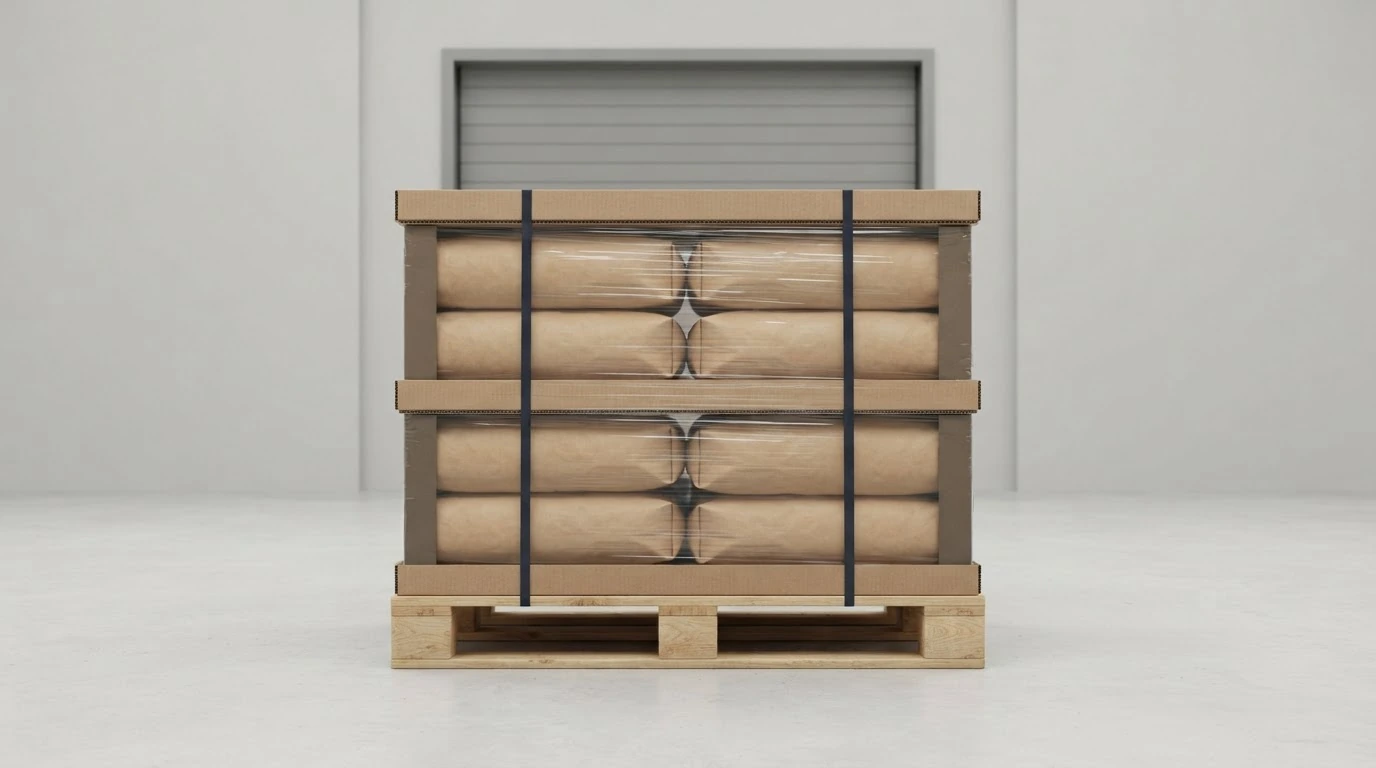
Bagged mortar, grout, aggregate, landscaping product, or similar dry material can shift shape and may be vulnerable to puncture and moisture. Use a base rated for the completed weight, a stable pattern, suitable bottom and tier sheets, edge or side protection, and restraint that keeps every bag within the pallet footprint.
FedEx’s bagged-product example calls for a tray over the pallet, an interlocked stack, tier sheets, a top tray, outside cardboard when possible, and stretch wrap plus banding. Apply that guidance only when it fits the product, bag construction, weight, pallet, and selected service.
Do not tender torn, leaking, wet, or loosely stacked bags. Stretch film is containment, not a substitute for a stable stack and structurally sound packaging.
Tile, brick, block, stone, and other dense materials
Design the base for the concentrated load and distribute weight through sound deck boards and blocks. Keep cartons or pieces within the footprint, protect faces and corners, separate abrasive surfaces, and prevent individual units from moving. Use rigid side or top protection when exposure or top loading could damage the product.
Do not assume that a low profile makes a pallet safe. Dense material can overload an inadequate base, create difficult fork entry, or shift violently if it is not restrained to the structure.
Sheet goods, doors, windows, countertops, and flat panels
Select a flat crate, elongated pallet, bookend-braced design, or purpose-built A-frame according to the product and manufacturer guidance. Support the full geometry, control bending and face pressure, protect all edges and corners, and keep glass, finish surfaces, and fittings away from restraint pressure.
FedEx’s guide recommends sturdy containers and braced elongated bases for large flat products. Whether the material should travel flat or upright is product-specific; a label is not a substitute for an engineered stable package.
Lumber, pipe, conduit, trim, and other long materials
Use a purpose-built skid or crate that supports the full length and prevents side-to-side and end-to-end movement. Protect sharp ends, prevent rolling, provide safe mechanical handling, and attach shipping documents to a stable outer surface.
FedEx specifically cautions against attaching unprotected long or non-profile freight to a pallet with banding alone because it lacks outer and end protection. Include the full crate, stringer, and projection dimensions in the quote.
Insulation, foam, and light bulky products
Protect the load from puncture, compression, moisture, and wind exposure during handling. Use an enclosure or rigid perimeter where appropriate, and select restraint that contains the product without crushing it. A light unit can still occupy substantial space or be difficult to stow.
State stackability truthfully. Do not add a rigid top cap unless the full package is designed to transfer top load safely through structural supports rather than through compressible product.
Metal hardware, coils, roofing, and fabricated components
Protect sharp edges, coated faces, corners, and protrusions. Prevent round or coiled items from rolling with purpose-built chocks or cradles, and secure dense pieces through a base designed for their concentrated load. Separate parts that could abrade one another and contain small hardware so it cannot escape the unit.
Do not route bands across unsupported sheet metal, finished edges, or flexible product. Use suitable edge protectors and anchor restraint to the structural package.
Step 4: Measure and classify the completed handling unit
NMFTA explains that the current National Motor Freight Classification evaluates commodities through density, handling, stowability, and liability (NMFTA: National Motor Freight Classification). Density matters for many items, but it does not justify one generic class for all dense masonry or all light insulation.
Measure the extreme packaged length, width, and height, including the pallet, crate, A-frame, overhang, corner protection, projections, and any non-stack device. Weigh the complete handling unit, not an individual product before packaging.
NMFTA’s packaging-and-class guidance notes that packaging changes the cubic footprint and that extreme dimensions include packing forms such as pallets, crates, and non-stack devices (NMFTA: Packaging and Class).
For each handling unit:
- Identify the actual commodity or commodities as prepared.
- Find the current applicable NMFC item and packaging provisions.
- Calculate density when the item requires it from verified finished measurements and weight.
- Check handling, stowability, liability, and carrier-tariff provisions.
- Retain the item, class, inputs, and source of the determination.
Do not classify a mixed pallet by whichever item seems dominant without confirming the current rules. Recheck the shipment if quantities, product mix, packaging, dimensions, weight, or stackability change.
Step 5: Confirm origin, destination, and unloading
A supplier may have a staffed dock while the destination is an active construction site, residence, retail yard, school, farm, storage location, gated project, or unfinished building. Describe what the carrier must physically do at both ends.
Confirm:
- whether a suitable dock, forklift, telehandler, or crane is available;
- whether a liftgate is requested and can accommodate the finished unit;
- whether the carrier must move freight beyond its standard pickup or delivery point;
- whether the carrier classifies the site as residential or limited access;
- appointment, notification, security, and business-hour requirements;
- road condition, turning space, grade, overhead clearance, and safe stopping area;
- who is responsible for unloading and whether qualified site personnel will be present; and
- whether prior approval or specialized equipment is required.
Liftgate capacity alone does not establish feasibility. Platform dimensions, package footprint, balance, surface conditions, and the plan for moving the freight after it reaches the ground can matter. Confirm the complete package and site with the selected provider.
Accessorial names, definitions, availability, limits, and charges are carrier-specific. Include the real service need in the quote instead of assuming a construction address always receives the same label or fee.
Step 6: Keep the tender consistent with the quote
Carry the same facts into the accepted quote, bill of lading, labels, and pickup:
- precise commodity descriptions and condition;
- handling-unit, package, and piece counts;
- extreme packaged dimensions and gross weight per unit;
- NMFC items and freight classes when applicable;
- hazardous-material information and documentation when required;
- truthful stackability and handling restrictions;
- origin, destination, dates, contacts, and site details;
- requested pickup and delivery services; and
- accepted pricing or service reference.
Before pickup, inspect the base, crate, frame, cartons, bags, restraints, edge protection, covers, labels, and documents. Look for broken boards, blocked fork entry, unstable weight, overhang, torn bags, loose pieces, sharp projections, moisture, leaking containers, and conflicting old labels. Photograph the complete prepared units from useful angles.
If a quote covered dry boxed tile on a stackable pallet, do not tender wet loose pieces under the same data. Request updated instructions and pricing when the freight changes.
Step 7: Prepare the jobsite receiver
Give the receiver the expected handling units, purchase-order or project references, unloading method, and inspection process. At delivery, compare visible count and condition before signing. Check bases, crates, bags, bands, wrap, top and side protection, exposed edges, moisture, and visible product damage.
Record specific visible exceptions on the delivery receipt when appropriate, photograph the condition, preserve the package and material, and follow the governing notice and claim procedures. Do not issue a blanket instruction to accept or refuse all damaged freight; safety, project urgency, contracts, carrier rules, and the type of damage can affect the appropriate response.
No packaging design, photograph, delivery notation, or declared value guarantees a claim outcome. The tariff, contract, packaging adequacy, evidence, timing, liability rules, and facts of the event can matter.
For repeat shipments, track exceptions such as broken base, torn bag, chipped tile, bent panel, wet product, restraint failure, overhang, reweigh, dimension correction, classification change, liftgate mismatch, missed appointment, or site refusal. Review patterns by SKU, supplier, pack design, warehouse, lane, carrier, and receiver.
Two building-material workflows without invented thresholds
Bagged product to a commercial warehouse
A distributor builds a stable unit using a rated pallet, bottom tray, consistent bag pattern, tier sheet, top tray, side protection, and validated restraint. It measures and weighs the finished load, confirms the current commodity classification, and quotes the destination as a staffed dock only after the receiver verifies the unloading arrangement.
Long finished components to a jobsite
A fabricator uses a purpose-built elongated crate with full-length support, end blocking, protected finished surfaces, and mechanical access. The jobsite confirms road access, appointment procedure, and unloading equipment. The shipper compares LTL with other modes using the actual crate and site facts rather than forcing the load under a generic length or pallet rule.
Neither workflow supplies an automatic class, rate, transit time, claim result, or recommended carrier.
Building-material LTL quote checklist
- Exact commodity, grade, form, quantity, and condition
- Hazardous-material determination when applicable
- Origin and destination postal codes and facility types
- Completed handling-unit and package counts
- Extreme packaged dimensions and gross weight per unit
- Current NMFC item and freight class when applicable
- Material-specific base, crate, frame, restraint, moisture, surface, edge, and end protection
- Truthful stackability and handling restrictions
- Pickup date, receiver hours, and unloading plan
- Liftgate, inside, limited-access, residential, appointment, notification, or other requested services
- Consistent quote, bill of lading, labels, and tendered freight
- Origin and delivery condition evidence
Shipocity is backed by a team with more than 40 years of combined logistics experience. Through established industry relationships, the platform helps businesses compare competitive freight rates for their specific shipment.
With the completed package, measurements, commodity details, and site requirements ready, Price this type of shipment.