How to Ship Agricultural Equipment by LTL Freight
Prepare agricultural equipment for LTL using fluid and battery checks, cleaning, component-specific packaging, finished measurements, and site details.
To ship agricultural equipment by LTL freight, identify the exact machine or component and its condition, follow manufacturer transport instructions, resolve fuel, fluid, battery, and hazardous-material status, clean and package the item, secure it to a stable forkliftable base, protect sharp and precision surfaces, measure and weigh the finished unit, confirm the current classification, and verify farm or dealer-site access.
LTL can fit an implement, attachment, pump, gearbox, hydraulic component, irrigation assembly, replacement part, or boxed hardware that can move safely through the selected carrier’s shared handling environment. It is not automatically right for every tractor, mower, baler, header, sprayer, or other machine. Finished geometry, weight concentration, wheels, moving parts, fluids, contamination, regulated materials, site access, and carrier acceptance determine the practical option.
Step 1: Identify the exact equipment and condition
Record each handling unit separately:
- equipment or component name, manufacturer, model, serial or order reference, and intended use;
- new factory-packed, new unpacked, used, returned, damaged, rebuilt, or scrap condition;
- self-powered, PTO-driven, hydraulic, electric, battery-powered, or passive configuration;
- fuel, oil, coolant, hydraulic fluid, fertilizer, pesticide, seed treatment, compressed gas, battery, or other contents;
- wheels, casters, blades, tines, shafts, booms, arms, hoses, cylinders, guards, hoppers, tanks, or loose accessories;
- manufacturer shipping brackets, pins, locks, skid, frame, lift points, fork pockets, and orientation instructions;
- extreme finished dimensions, gross weight, and center of gravity; and
- origin and destination surfaces, facilities, contacts, hours, and unloading equipment.
Do not infer preparation from the word “agricultural.” A clean boxed sensor, used hydraulic pump with residual oil, battery-powered controller, long irrigation bundle, and soil-covered implement require different decisions.
If the machine is operational, wheeled, unusually long or wide, top-heavy, crane-dependent, difficult to enclose, or unsuitable for terminal handling, compare LTL with a realistic specialized option. Do not rely on a universal pallet count, machine type, or weight limit.
Step 2: Resolve fluids, batteries, and regulated materials
Do not apply one generic fuel-draining rule to every machine. Obtain the current manufacturer instructions, identify the actual contents and residue, and confirm the carrier’s preparation and acceptance rules.
FedEx’s current automotive-parts guidance illustrates a carrier-specific approach: it calls for fluid-containing parts to be drained or demonstrated leakproof in every orientation, protects sharp surfaces, and gives separate preparation for transmissions and other components (FedEx: How to Ship Automotive Parts). Use that guidance only when the carrier and equipment scenario match.
PHMSA’s Check the Box program explains that familiar products can be hazardous materials and introduces shipper responsibilities for classification, packaging, marks, labels, documents, and training (PHMSA: Check the Box Brochure). Agricultural equipment or accompanying supplies may involve fuels, batteries, aerosols, pesticides, fertilizers, compressed gases, or other regulated materials.
Before tender:
- Identify every content and residue using manufacturer and safety information.
- Determine the proper shipping description, hazard class, identification number, packing group when applicable, and any exception under current regulations.
- Protect battery terminals and prevent accidental activation when required.
- Use authorized packaging and complete required marks, labels, shipping papers, emergency information, and training.
- Confirm that the selected carrier and service accept the item as prepared.
Damaged or leaking equipment and damaged, defective, or recalled batteries can require different treatment from sound production equipment. Use qualified hazardous-material help when the status is unclear.
Step 3: Clean used equipment and check route-specific rules
Remove loose soil, manure, seed, crop residue, pests, and other debris before packaging so the freight can be inspected and handled safely. Cleaning should not damage bearings, seals, electronics, finishes, or manufacturer labels.
Additional government requirements can apply to cross-border or regulated-origin movements. USDA APHIS states that unclean farm machinery imported from any country is subject to soil or contamination restrictions and that used equipment from certain countries can require official steam-cleaning certification (USDA APHIS: Core Message Set Questions and Answers).
That is an import rule, not a claim that every domestic LTL shipment needs a certificate. For an international, territorial, quarantine-area, or otherwise regulated route, confirm current agriculture, customs, wood-packaging, soil, pest, and documentation requirements before tender.
Do not package wet, soil-covered equipment and assume the outer wrap solves the issue. Record the cleaning condition and preserve any required evidence.
Step 4: Package for the equipment form
FedEx’s current freight-packing guide distinguishes pallets, crates, blocking, bracing, banding, stretch wrap, long-freight protection, and concentrated-load controls (FedEx: Freight Packing and Packaging Guidelines). Treat it as carrier-specific guidance and verify the requirements for the service being considered.
A qualified packaging or rigging reviewer should assess a new design, used machine, high-value component, sharp implement, heavy concentrated load, or repeat production shipment.
Pumps, gearboxes, motors, and dense components
Use a base and blocking designed for the concentrated weight. Secure the component through approved mounting feet or a purpose-built cradle so it cannot slide, rotate, or tip. Protect shafts, splines, machined faces, threads, seals, gauges, connectors, and ports.
Cap openings with suitable fitted closures, use compatible containment for permitted residue, and keep stretch film from being the primary restraint for a heavy component.
Hydraulic cylinders, valves, hoses, and assemblies
Retract and secure rods when the manufacturer permits, protect polished surfaces, cap ports, contain approved residue, prevent hose movement, and keep fittings from bearing load. Use partitions or cradles so components cannot strike one another.
Do not use hoses or tubing as tie points. A visually dry fitting can still contain fluid; determine the actual status before packing.
Blades, tines, cutters, forks, and sharp implements
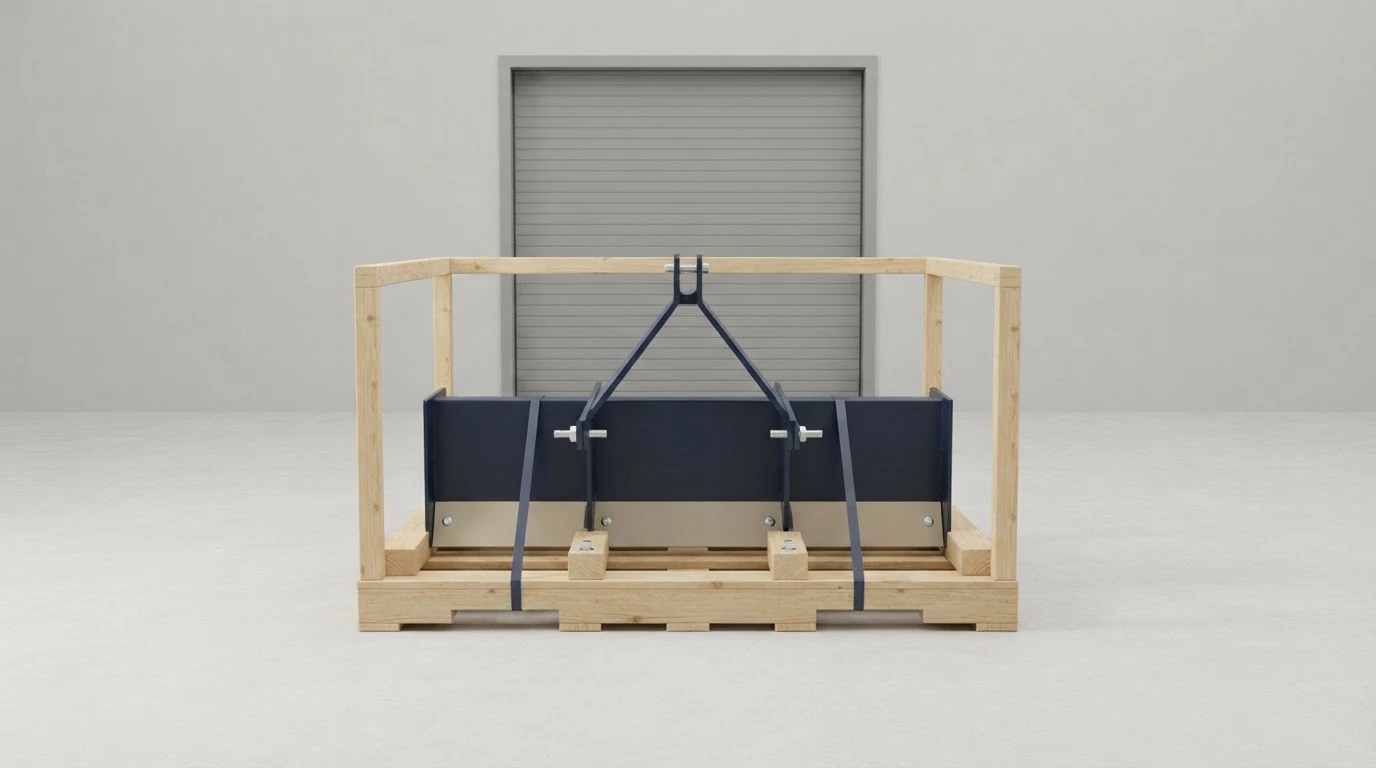
Immobilize moving sections with manufacturer transport locks, pins, or approved restraints. Cover every sharp point and cutting edge with a rigid guard that cannot slip off. Use a crate or frame that prevents the implement from cutting packaging, handlers, or adjacent freight.
Restrain through the structural frame, not through a blade edge, thin guard, or flexible tine. Include all protective guards in the finished dimensions.
Wheeled attachments and compact implements
Prevent rolling with purpose-built chocks, blocking, and structural restraint. Lower or remove approved stands, handles, booms, or attachments only according to the manufacturer instructions. Secure steering, pivoting, folding, and suspended components.
The wheels should not be the only load path if the package could shift or bounce. Use a skid or crate that can be moved mechanically without contacting tires, axles, driveline parts, or controls.
Irrigation pipe, rails, booms, and other long components
Use a full-length skid or crate that prevents bowing, rolling, side-to-side movement, and end-to-end travel. Protect ends, fittings, emitters, threads, and coated surfaces. Contain small connectors and hardware in separately identified internal packages.
FedEx cautions against attaching unprotected long or non-profile freight to a pallet with banding alone. Include every stringer, end block, projection, and protective member in the finished dimensions.
Boxed parts and mixed dealer orders
Use cartons rated for the parts and stack them in a stable pattern on a sound pallet. Separate dense metal parts from light or fragile cartons, protect precision surfaces, and keep small hardware contained. Record contents by handling unit.
Do not assume every commodity on a mixed pallet shares one NMFC item or class.
Step 5: Measure and classify the finished handling unit
NMFTA explains that the current National Motor Freight Classification evaluates commodities through density, handling, stowability, and liability (NMFTA: National Motor Freight Classification). Density matters for many items, but it does not create one generic class for agricultural machinery or parts.
Measure the extreme packaged length, width, and height, including the pallet, skid, crate, guards, overhang, corner protection, projections, and any non-stack device. Weigh the complete handling unit, not the bare machine or component.
For each unit:
- Identify the actual commodity or commodities as prepared.
- Find the current applicable NMFC item and packaging provisions.
- Calculate density when the item requires it from verified finished measurements and weight.
- Check handling, stowability, liability, hazardous-material, and carrier-tariff provisions.
- Retain the item, class, inputs, and source of the determination.
Do not copy the class from a different implement, component, package, or condition. Recheck the data when guards, attachments, skid, crate, dimensions, weight, or stackability change.
Step 6: Verify dealer, farm, ranch, and rural access
The origin may have a dock while the destination is a dealer yard, farm, ranch, field entrance, rural shop, residence, school, auction location, storage building, or unpaved site. Describe what the carrier must physically do.
Confirm:
- whether a suitable dock, forklift, telehandler, tractor loader, or crane is available;
- whether a liftgate is requested and can accommodate the complete unit;
- platform size, package footprint, center of gravity, and movement after ground placement;
- whether the carrier classifies the site as residential or limited access;
- appointment, notification, gate, livestock, security, and business-hour requirements;
- road width, bridge or culvert limits, surface, mud, grade, turning space, overhead clearance, and safe stopping area;
- who unloads and whether trained personnel and appropriate equipment will be present; and
- whether prior approval or specialized equipment is required.
A liftgate’s stated weight capacity does not prove that an implement is safe to handle. Package footprint, balance, protrusions, platform support, ground condition, and a plan for moving it after placement can matter.
Accessorial names, site definitions, availability, limits, and charges are carrier-specific. Do not assume every farm is automatically residential or limited access; describe the real location and obtain the provider’s determination.
Step 7: Keep the tender consistent with the quote
Carry the same facts into the accepted quote, bill of lading, labels, regulatory documents, and pickup:
- precise equipment and condition descriptions;
- handling-unit, package, and attachment counts;
- extreme packaged dimensions and gross weight per unit;
- NMFC items and freight classes when applicable;
- fuel, fluid, battery, and other regulated-material information when required;
- truthful stackability, orientation, and handling restrictions;
- origin, destination, dates, contacts, and site details;
- requested pickup and delivery services; and
- accepted pricing or service reference.
Before pickup, inspect the base, crate, restraints, locks, pins, guards, caps, chocks, equipment, labels, and documents. Look for unstable weight, unrestrained movement, leaking fluid, exposed sharp points, soil or crop debris, blocked fork entry, overhang, loose accessories, and conflicting labels. Photograph the complete prepared units from useful angles.
If a quote covered a clean dry crated gearbox, do not tender a leaking loose assembly under the same data. Request updated instructions and pricing when the freight changes.
Step 8: Prepare receiving and preserve condition evidence
Give the receiver the equipment identifiers, handling-unit and accessory counts, unloading plan, and inspection process. At delivery, compare visible count and condition before signing. Inspect the base, crate, bands, blocks, guards, shafts, fittings, hoses, tires, panels, controls, and accessible parts without creating an unsafe unpacking situation.
Record specific visible exceptions on the delivery receipt when appropriate, photograph the condition, preserve the package and equipment, and follow the governing notice and claim procedures. Do not issue a blanket instruction to accept or refuse every damaged shipment; safety, contracts, carrier rules, operating urgency, and the type of damage can affect the appropriate response.
No photograph, notation, package design, cleaning record, or declared value guarantees a claim outcome. The tariff, contract, packaging adequacy, evidence, timing, liability rules, and facts of the event can matter.
For repeat shipments, track exceptions such as broken skid, loose implement, damaged shaft, exposed blade, leaking fitting, soil contamination, missing attachment, reweigh, dimension correction, classification change, liftgate mismatch, or site refusal. Review patterns by model, supplier, package design, warehouse, lane, carrier, and receiver.
Two agricultural-equipment workflows without invented thresholds
New pump assembly to a farm-supply dealer
The shipper caps ports, mounts the pump through approved feet to a rated base, blocks movement, protects machined surfaces, records finished measurements, and confirms current classification. The dealer verifies its commercial dock and unloading equipment before the quote is accepted.
Used compact implement to a rural property
The owner obtains the manufacturer transport instructions, cleans the implement, resolves fluid and battery status, locks moving sections, guards sharp points, and secures the frame to a forkliftable skid. The receiver confirms road access, appointment process, and suitable unloading equipment. Cross-border rules are checked separately if the route requires them.
Neither workflow supplies an automatic class, rate, transit time, claim result, or recommended carrier.
Agricultural-equipment LTL quote checklist
- Exact equipment or component, manufacturer, model, quantity, and condition
- Fuel, oil, coolant, hydraulic fluid, battery, chemical, and hazardous-material status
- Cleaning and route-specific agriculture requirements when applicable
- Origin and destination postal codes and facility types
- Completed handling-unit and attachment counts
- Extreme packaged dimensions and gross weight per unit
- Current NMFC item and freight class when applicable
- Manufacturer transport locks, pins, brackets, orientation, lifting, and securement instructions
- Equipment-specific base, crate, blocking, guards, caps, chocks, surface, and end protection
- Truthful stackability and handling restrictions
- Pickup date, receiver hours, and unloading plan
- Liftgate, inside, limited-access, residential, appointment, notification, or other requested services
- Consistent quote, bill of lading, labels, regulatory documents, and tendered freight
- Origin and delivery condition evidence
Shipocity is backed by a team with more than 40 years of combined logistics experience. Through established industry relationships, the platform helps businesses compare competitive freight rates for their specific shipment.
With the completed package, measurements, equipment details, and site requirements ready, Price this type of shipment.