How to Reduce Freight Damage Before It Happens
Reduce LTL freight damage with a practical pre-pickup process for packaging, palletizing, securement, labeling, service selection, and condition records.
You reduce freight damage before pickup by treating the shipment as a complete handling unit, not as a product sitting on a pallet. The product needs packaging that controls its own failure risks. The pallet or crate needs to support the final packed weight. The stack needs to resist shifting and compression. Securement needs to keep the freight and base together. Any handling condition outside normal LTL service needs to be quoted and confirmed before tender.
No checklist can guarantee a damage-free delivery. It can, however, remove preventable weaknesses and make the shipment’s condition easier to prove if something goes wrong.
Design for the LTL trip the freight will actually take
LTL packaging has to tolerate more than a smooth linehaul ride. The National Motor Freight Traffic Association describes fork-tine handling, vibration, vertical shock, braking and turning forces, trailer loading, and changes in temperature and humidity as normal parts of the LTL environment. The freight may also move through service centers and occupy different positions in different trailers (NMFTA).
That leads to a practical design question: if the handling unit is lifted, turned, vibrated, placed beside other freight, or exposed to ambient conditions, what is most likely to fail first?
Common failure points include:
- contents moving inside an outer carton or crate;
- cartons crushing because weight is concentrated or unsupported;
- a tall or uneven load leaning when the vehicle turns or brakes;
- product overhang taking a direct impact instead of the pallet;
- bands cutting into carton edges;
- stretch film loosening while the load works against it;
- moisture or temperature changes weakening the product or packaging; and
- fork access that puts the product in the path of the tines.
Build the prevention plan around the actual commodity and the first credible failure point, not around a generic wrapping routine.
A seven-step pre-pickup damage-control process
1. Identify the product’s failure modes
Start with what can bend, crack, puncture, leak, abrade, corrode, absorb moisture, lose calibration, or become unstable. Record the product weight, center of gravity, dimensions, surface sensitivity, orientation requirements, and whether individual pieces can move inside the package.
Then check the packaging rule or specification that applies to the commodity. NMFTA explains that the National Motor Freight Classification includes general packaging specifications, approved packaging for particular commodities, and performance-based packaging provisions. A familiar box or crate is not automatically suitable for every product or every LTL movement (NMFTA LTL Packaging).
Hazardous materials, food, pharmaceuticals, batteries, temperature-sensitive products, and other regulated goods require shipment-specific compliance beyond this general guide. Verify current legal, carrier, packaging, marking, documentation, and equipment requirements with qualified personnel before tender.
2. Choose a base or enclosure that supports the packed load
Use a sound, forklift-accessible base sized for the finished handling unit. The product should stay within the pallet perimeter unless the carrier has accepted a different arrangement. A damaged pallet, missing deck board, inadequate fork clearance, or unsupported concentrated load can defeat otherwise careful packaging.
FedEx’s current freight guide encourages palletizing LTL freight because it can reduce damage risk and improve handling efficiency. It also advises choosing a wood or plastic pallet that can withstand compression, shock, and vibration and that provides forklift openings (FedEx). Those are useful design principles, but confirm the selected carrier’s current limits and approval rules for the shipment you are booking.
Use a crate or engineered enclosure when exposed surfaces, irregular geometry, concentrated weight, or fragility make an open pallet unsuitable. Blocking and bracing should restrain the product inside the crate; the walls should not be expected to stop a heavy item that can slide freely into them.
3. Control movement inside the package
Outer securement cannot correct an unstable product inside a carton or crate. Use cushioning, dividers, blocking, bracing, sleeves, or custom inserts appropriate to the item’s weight and fragility. Protect sharp edges and protrusions so they cannot cut the container or adjacent freight.
For a repeated product, test the complete package rather than assuming more material is always better. NMFTA identifies performance-based packaging under NMFC Items 180 and 181 for qualifying designs and notes that the applicable testing and certification process uses registered laboratories (NMFTA LTL Packaging). A packaging engineer or qualified test lab is the right next step when a recurring shipment continues to fail.
4. Build a stable, supportable stack
Place the heaviest suitable cartons at the bottom, keep the center of mass low, and distribute weight over the pallet structure. Keep carton corners aligned when the packaging design depends on vertical compression strength. Do not leave a heavy upper carton bridging an unsupported void.
Column stacking and interlocking stacking are not interchangeable rules. FedEx notes that column stacking generally preserves more top-to-bottom compression strength, while interlocking can add stability when carton contents are rigid (FedEx). Choose the pattern that matches the cartons and contents, then use tier sheets or other support where the design calls for them.
Do not assume a Do Not Stack label controls trailer loading. NMFTA states that a non-stack notation, physical indicator, or bill-of-lading instruction does not guarantee special handling unless that service has been quoted, agreed to, and confirmed before shipment (NMFTA). If the load cannot support anything above it, disclose that during quoting and obtain the carrier’s current service terms.
5. Secure the freight to the base
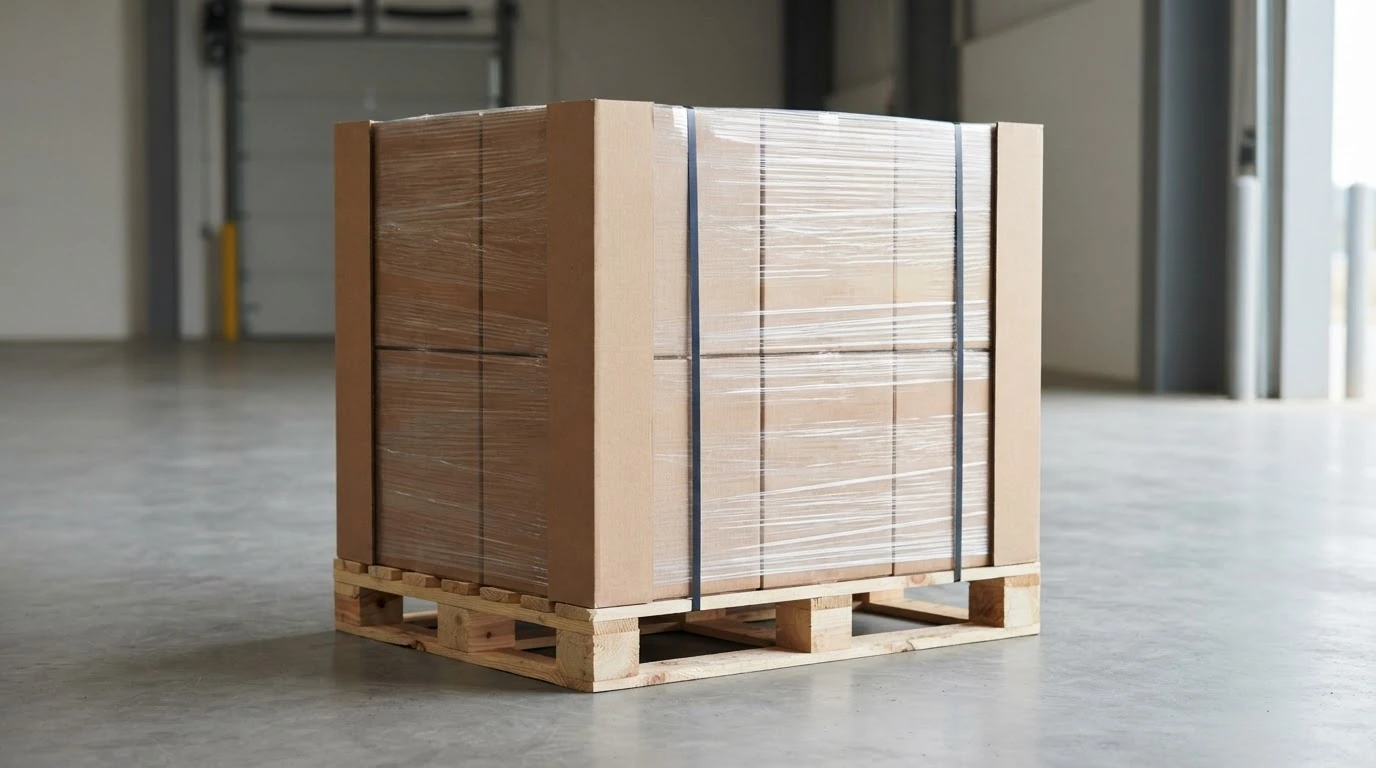
The pallet and product should move as one handling unit. Use the combination of bands, stretch film, edge protection, top caps, or other restraints called for by the load design.
XPO’s current packaging guide recommends edge boards to protect corners and distribute band pressure, bands anchored beneath the pallet’s top deck boards, and stretch wrap tied into the pallet from the bottom upward. It also emphasizes preventing shifting on the dock and in the trailer (XPO).
Before release, check securement in both directions. A load restrained across its width can still move along its length. Bands should be tensioned and applied with compatible tools and protectors; they should not crush cartons or contact an unprotected delicate surface. Stretch film should contain the load and connect it to the base rather than merely cover the cartons.
6. Make identification and special handling explicit
Apply the shipment identifiers and consignee information required by the carrier to the handling unit where they remain visible and secure. Remove or cover obsolete labels that could misroute the freight. Use orientation or precautionary markings only when they accurately describe a real handling requirement.
Labels communicate; they do not create a service commitment. If the freight requires nonstandard loading, temperature control, protection from freezing, an appointment, inside service, a liftgate, limited-access handling, or another special condition, include it in the quote request and confirm it in the booking documents. Do not rely on a sticker or handwritten note to add a service after the rate is accepted.
7. Run a final condition and paperwork check
Perform the last inspection after packaging, palletizing, and securement are complete. Measure the extreme length, width, and height of the finished handling unit and weigh the finished shipment. Make the piece count, packaging type, commodity description, dimensions, weight, class or NMFC information when applicable, and requested services consistent across the quote, bill of lading, and labels.
Photograph each complete handling unit from enough angles to show the packaging, pallet, securement, labels, and visible condition at tender. Keep the photos with the quote, bill of lading, packing list, value records, and pickup record. This is a condition record, not proof that a carrier is automatically liable for a later loss.
For covered U.S. interstate motor-carrier shipments, 49 U.S.C. 14706 supplies a federal liability framework and permits liability limits in specified written or electronic arrangements. The governing rate, classification, rules, bill of lading, contract, shipment mode, and facts still matter (U.S. House Office of the Law Revision Counsel). For a high-value, regulated, cross-border, contract-specific, or legally disputed shipment, have qualified counsel or an experienced freight-claims professional review the governing documents and protection options before pickup.
Match the control to the freight
| Freight characteristic | Primary risk to address | Pre-pickup control to evaluate |
|---|---|---|
| Dense machinery or a product with feet | Concentrated load, tipping, fork contact | Engineered base or crate, blocked contact points, low center of mass, restraint in both directions |
| Uniform cartons | Compression, overhang, leaning | Sound pallet, aligned stack, supported layers, edge protection, bands and wrap tied to the base |
| Bags or flexible packages | Shifting, puncture, changing shape | Palletized unit, suitable trays or tier sheets, perimeter protection, containment and banding appropriate to the product |
| Drums or pails | Rolling, sliding, leakage, unstable tiers | Compatible solid or anti-skid deck, blocking, edge protection, banding and containment suited to the container |
| Reels, spools, or long pieces | Rolling, bending, fork damage | Forklift-accessible base, chocks or blocking, bracing, protected restraint points |
| Moisture- or temperature-sensitive goods | Package weakening or product degradation | Verified barrier packaging, condition monitoring when appropriate, and a confirmed service that matches the product requirement |
| Non-stackable or unusually fragile freight | Top load and contact with adjacent freight | Packaging designed for normal LTL forces or a specifically quoted and confirmed special-handling arrangement |
The carrier guides are starting points, not substitutes for the product manufacturer’s instructions, the applicable NMFC provision, a packaging engineer’s design, or the booked carrier’s current rules.
The dock-door rejection test
Do not tender the handling unit until each answer is clear:
- Is the pallet or crate structurally sound and compatible with the handling equipment?
- Does every product edge stay within or receive engineered protection beyond the base?
- Can anything move inside its carton, inside the crate, or across the pallet?
- Are heavy items supported and the center of mass stable?
- Are corner boards, bands, wrap, blocking, and bracing intact and correctly placed?
- Can fork tines enter without contacting the product?
- Can the packaging tolerate ordinary vibration, braking, turning, ambient conditions, and expected top load?
- Are labels current, secure, readable, and consistent with the shipment documents?
- Are all nonstandard handling and service requirements present in the accepted quote or booking?
- Do the final dimensions, weight, count, commodity description, and class information match the finished freight?
- Has the completed handling unit been photographed and tied to the shipment record?
If one answer is uncertain, pause the pickup and resolve it. Reworking a pallet at the dock is usually simpler than investigating a failure after delivery.
Details to gather for the quote
Have these ready before comparing services:
- origin and destination ZIP codes;
- pickup date and any real delivery constraint;
- final packaged dimensions and total weight;
- pallet, crate, drum, or piece count;
- clear commodity description;
- freight class and NMFC item when known and applicable;
- stackability and any specifically required handling condition;
- pickup and delivery site details, including dock or liftgate needs;
- residential, limited-access, inside, appointment, or temperature-control requirements; and
- shipment value and the applicable carrier-liability or separate coverage decision.
Shipocity is backed by a team with more than 40 years of combined logistics experience. Through established industry relationships, the platform helps businesses compare competitive freight rates for their specific shipment. When the handling unit is ready, quote it with the final shipment details.