How Much Does a Shipping Pallet Weigh?
A standard 48x40 GMA wood pallet typically weighs 30 to 50 lbs empty. Learn how pallet type, load capacity, and carrier caps affect your LTL freight quote.
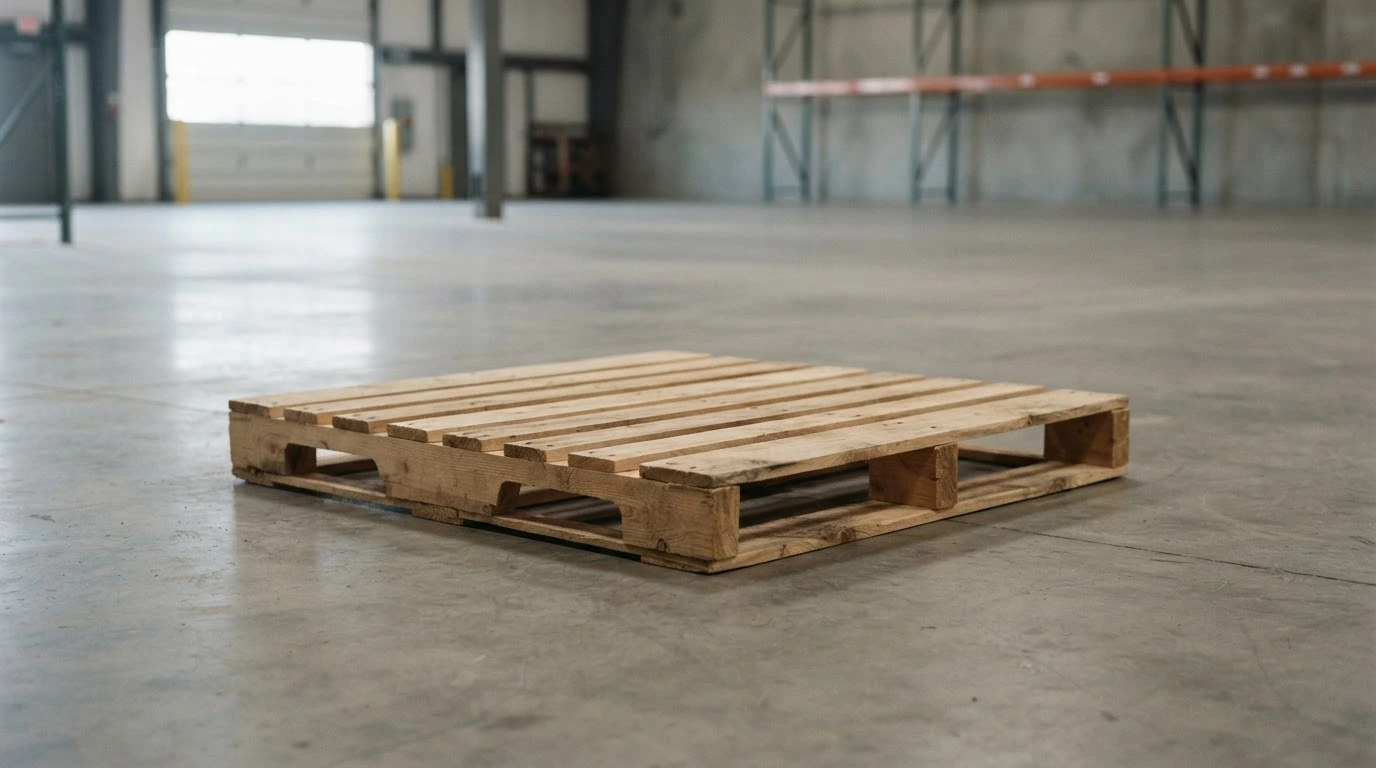
A common 48-by-40-inch wood stringer pallet weighs about 40 pounds empty, but that is a planning estimate, not a universal standard. A different wood design may weigh much more, and plastic, pressed-wood, metal, or custom pallets each have their own tare weight.
For an LTL quote, use the actual weight of the finished handling unit: product plus pallet plus every piece of packaging and securement. If the pallet is already loaded, weighing the completed unit is more reliable than adding a generic pallet estimate.
Typical pallet weights are examples, not guarantees
Pallet material alone does not determine weight. Size, construction, moisture, repairs, reinforcements, and the specific design all matter.
Current published examples show how wide the range can be:
| Pallet example | Published empty weight | What the number means |
|---|---|---|
| 48-by-40-inch wood stringer pallet | About 40 lb | A common planning figure published by iGPS for a standard stringer design |
| Wood block pallet | About 65-75 lb | An iGPS example for a sturdier block-style wood pallet |
| iGPS 48-by-40-inch plastic pallet | About 48.5-54 lb, depending on model | Product-specific weights from the current iGPS specification table |
These are useful reference points, but they do not establish the weight of every pallet in a category. A lightweight export pallet and a reusable pooled pallet can share the same footprint while differing substantially in construction and tare weight.
If a quote or bill of lading needs an accurate number, identify or weigh the pallet you will actually ship.
What changes a wood pallet’s weight?
Construction
A stringer pallet uses longitudinal boards to support the deck. A block pallet uses blocks between its decks and commonly has more material. Board thickness, deck coverage, stringer or block size, and fasteners all affect the result.
A repaired pallet may also contain replacement boards or companion stringers that make it different from a new pallet of the same nominal style. Custom skids and engineered bases should be treated as their own designs, not assigned a generic 40-pound tare.
Wood species and moisture
Wood density varies by species and growing conditions. Moisture changes the weight further. The National Wooden Pallet and Container Association’s Pallet Design System documentation explains that estimated pallet weight is tied to component weight and moisture content, and that pallet weight decreases as lumber dries.
That means a damp pallet can weigh more than a dry pallet built to the same specification. It also explains why an estimate taken from a catalog or another pallet should not replace an actual scale reading when accuracy matters.
Size and condition
The 48-by-40-inch footprint is common in North America, but it is not the only pallet size. Larger footprints and taller or more heavily built bases usually add material. Broken boards do not turn a damaged pallet into a safely lighter pallet; damage is a reason to inspect or replace the base before shipping.
Plastic pallet weight also varies
It is inaccurate to say plastic pallets are always lighter than wood pallets. Some nestable export designs are very light, while reusable rackable plastic pallets can weigh about as much as a common wood stringer pallet or more.
iGPS, for example, lists its 48-by-40-inch plastic models at approximately 48.5 pounds, 50-54 pounds, or about 50 pounds, depending on the generation. Those figures apply to those models. Another plastic pallet can have a different deck pattern, reinforcement, rackability, and weight.
The same rule applies to pressed-wood, corrugated, composite, or metal pallets: use the product specification or a scale reading for the exact base.
Tare weight and load capacity are different
Pallet weight is the tare weight of the empty base. Load capacity describes how much weight the pallet is designed to support under stated conditions. A heavy pallet is not automatically stronger, and a light pallet is not automatically unsuitable.
Capacity can also change with the support condition. A specification may provide different limits for a pallet resting on a floor, moving on forklift tines, or spanning rack beams. Load distribution matters too. A uniformly distributed carton load can stress a pallet differently from a narrow machine or drum with the same total weight.
Use the manufacturer’s or pallet supplier’s rating for the exact design and the actual handling condition. Do not infer capacity from tare weight, footprint, appearance, or a number published for another pallet.
Carrier acceptance is a separate question again. A pallet can be structurally capable of carrying a load that a particular carrier, service, pricing program, liftgate, or receiving facility will not accept. Verify those limits when the finished handling unit is unusually heavy.
Use gross pallet weight for an LTL quote
The freight weight entered on a quote should include the entire handling unit:
- Product
- Pallet or skid
- Cartons or crate
- Dunnage, blocking, and bracing
- Stretch wrap, bands, corner protection, and top cap
- Any other packaging attached to the shipment
Suppose the product itself weighs 960 pounds and the pallet and packaging together weigh 55 pounds. The handling unit weighs 1,015 pounds for quoting purposes. Do not enter 960 pounds and assume the pallet will be added later.
For multiple pallets, record the gross weight of each handling unit when practical. Individual weights help identify a pallet that may approach a carrier, program, or equipment limit even when the shipment’s total weight is acceptable.
Why a few pounds can matter
An omitted pallet may not look significant beside a heavy product, but accurate gross weight still matters for several reasons.
First, weight and packaged dimensions are used to calculate density. NMFTA advises using accurate measurements rather than estimates when calculating density. Freight classification considers density together with handling, stowability, and liability, as well as the applicable NMFC provisions.
Second, current NMFTA guidance for Item 250100 confirms that carriers may verify shipment weight and dimensions. A discrepancy can make the original quote or shipping information inaccurate.
Third, the extra weight becomes more meaningful across several pallets. A 40-pound omission repeated across ten handling units leaves 400 pounds out of the shipment total.
How to get the right pallet weight
Use the most reliable method available:
- Weigh the finished pallet. This captures the base, product, and packaging in one measurement.
- Weigh an identical empty pallet. Use this when product weight is already known and the pallet design is consistent.
- Use the exact specification. A manufacturer or pool operator’s model-specific tare is better than a category-wide estimate.
- Use an estimate only for early planning. Mark it as an estimate and replace it before tendering the shipment.
If reused wood pallets vary in design, repair history, or moisture, weighing a single sample may not represent the whole group. Weigh each completed unit or use a documented process that accounts for the variation.
What to gather before requesting a quote
Have these details ready:
- Gross weight of each finished pallet
- Finished length, width, and height at the farthest points
- Pallet count and total piece count
- Specific commodity description
- NMFC item and freight class when known
- Origin and destination ZIP codes
- Stackability and special handling needs
- Dock, forklift, pallet-jack, or liftgate requirements
- Residential, limited-access, inside, appointment, or other requested services
Shipocity is backed by a team with more than 40 years of combined logistics experience. Through established industry relationships, the platform helps businesses compare competitive freight rates for their specific shipment.
Once the finished dimensions and gross weight are ready, get a freight quote and create your Shipocity account.