Freight Pickup or Delivery at a Farm or Ranch
Plan farm or ranch freight pickup or delivery by confirming carrier classification, vehicle access, unloading equipment, contacts, and required location services.
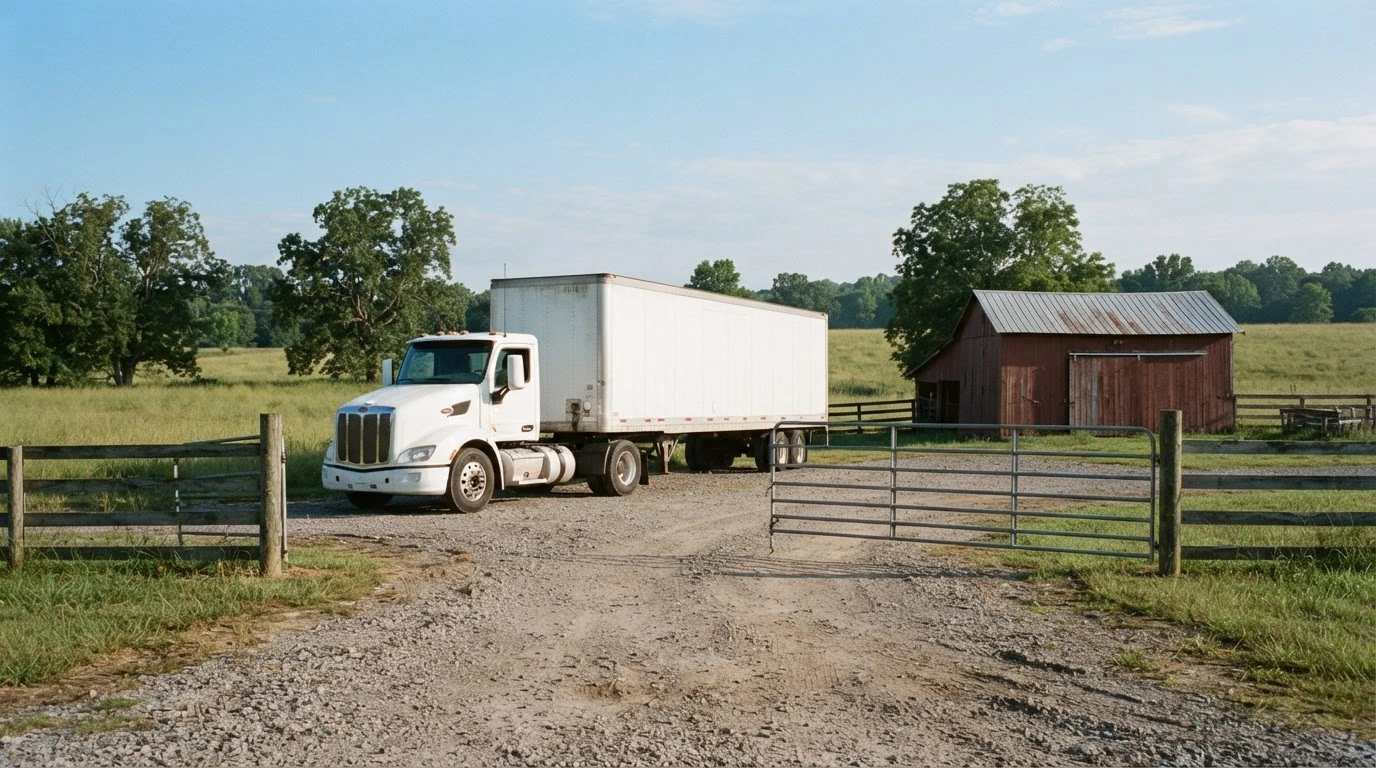
Freight pickup or delivery at a farm or ranch should be quoted for the location as it actually operates, not as a generic commercial address. Tell the rate provider that the stop is a farm or ranch, then confirm the selected carrier’s location classification, vehicle access, loading or unloading method, contact procedure, and any added services before booking.
That advance work matters because a farm address does not create one universal carrier rule. Current Southeastern Freight Lines and TForce Freight rules expressly include farms and ranches among limited-access locations. Estes lists farms or estates and rural or residential areas in its limited-access rule. FedEx Freight uses a different limited-access definition. The applicable service and charge therefore come from the selected carrier’s current rules and the facts of the stop, not from a label that every carrier applies in the same way.
Separate the location from the commodity
“Farm delivery” describes where the truck will stop. It does not identify what is being shipped or which equipment the freight requires.
A pallet of packaged parts may be suitable for an LTL network. A large implement, temperature-controlled product, bulk material, hazardous material, or live animal may require a different service, equipment type, or specialist carrier. Establish commodity eligibility and equipment needs separately from the farm-or-ranch access question. Do not assume that selecting limited access makes an otherwise unsuitable shipment acceptable.
For an LTL quote, prepare the shipment’s fully packaged dimensions, weight, piece or pallet count, accurate commodity description, freight class when known, and any special handling requirements. The quote also needs the real origin and destination conditions. A correct commodity description does not compensate for an undisclosed limited-access stop, and a correct address does not compensate for incomplete shipment details.
Determine how the carrier classifies the stop
Describe the location plainly when requesting the rate. If the quoting workflow offers farm, ranch, limited-access pickup, or limited-access delivery, select the option that matches the stop. If the available choices do not make the classification clear, ask how the carrier will treat the location before tendering the shipment.
Do not substitute residential service just because a farmhouse shares the property. Residential and limited-access services can have separate definitions and charges. Likewise, do not assume that a farm with a business name and normal receiving hours will be treated as a standard commercial dock. The carrier’s tariff, pricing agreement, and service terms control.
The pickup side and delivery side should be evaluated independently. A shipment can leave a staffed warehouse and arrive at a ranch, or leave a farm and arrive at a commercial dock. TForce Freight’s published rule, for example, applies its limited-access provisions separately to pickup and delivery. Quote the condition at each end rather than copying one location type to both.
Check whether the truck can reach a safe handoff point
Before dispatch, ask the site contact to evaluate the route from the public road to the proposed loading or unloading point. The carrier needs a workable place to enter, position the vehicle, complete the handoff, and leave without relying on an assumption made from a map pin.
Confirm:
- The physical street address and the correct entrance, not only a mailing address or property name
- Whether a tractor-trailer can use the entrance, internal lane, and receiving area
- Road surface and current condition, including mud, soft shoulders, steep grades, or seasonal restrictions
- Gate width, gate schedule, locks, and who can open the property when the truck arrives
- Low branches, wires, eaves, bridges, cattle guards, or other clearance and weight concerns
- A firm, reasonably level area where the vehicle can stop and where freight can be handled
- Enough room for the expected equipment to turn around or an approved plan for leaving the site
- Separation from livestock, loose pets, irrigation equipment, parked machinery, and active farm work
These are planning questions, not a promise that a carrier will enter the property. Give the carrier accurate conditions and follow its decision about the permitted handoff point. If the full-size vehicle cannot safely reach the proposed spot, resolve an alternate location, suitable equipment, or terminal pickup before booking rather than expecting the driver to improvise.
Choose each accessorial for the work actually needed
Limited access, liftgate, inside service, and an appointment solve different problems. One does not automatically include the others.
| Service question | What to verify |
|---|---|
| Limited-access pickup or delivery | Whether the selected carrier classifies the farm or ranch under that service at the origin, destination, or both |
| Liftgate | Whether freight must move between trailer height and ground level because a usable dock or suitable loading equipment will not be available |
| Inside pickup or delivery | Whether the requested handoff goes beyond the carrier’s standard loading or unloading position, and whether the carrier offers that work at this site |
| Appointment or notification | Whether the carrier will arrange a date or time, provide only advance notice, or includes an initial contact under another service rule |
| Redelivery | What happens if the carrier reaches the stop but the site is closed, inaccessible, or not ready to receive |
R+L Carriers’ current accessorial documentation is a useful illustration: it lists limited-access pickup, limited-access delivery, origin and destination liftgate, inside service, and delivery appointment as separate selections. Other carriers may define or bundle them differently, so use the selected quote and current carrier terms.
A liftgate is not a substitute for a clear unloading plan. Confirm that each packaged handling unit fits the selected carrier’s equipment limits and that there will be a suitable surface at ground level. If the farm plans to unload with its own forklift, tractor attachment, telehandler, or other equipment, the site is responsible for confirming that the equipment, operator, capacity, forks or attachment, and approach are suitable for the actual freight. Do not describe equipment merely as “available” without checking what it can safely handle.
Inside service also should not be used as shorthand for “take it to the barn.” The carrier’s standard delivery point and the limits of any inside service are carrier-specific. State the requested handoff point and confirm what the quoted service includes.
Put useful site information on the shipping record
Current Southeastern and Estes rules tell shippers to identify a limited-access pickup or delivery on the shipping order or bill of lading and provide the contact’s name, telephone number, and full address. That is a sound preparation pattern even though the exact document fields and carrier requirements vary.
Provide the selected carrier with:
- The complete physical address and entrance directions
- The on-site contact’s name and a phone number that will be answered during the delivery period
- Receiving days and hours, plus any times when gates or internal roads are unavailable
- The agreed loading or unloading point
- The accessorials included in the quote
- Material access constraints and the loading or unloading equipment expected on site
- A shipment reference the receiver will recognize
Keep directions concise and operational. Do not put sensitive gate codes or unnecessary personal information into broadly shared notes. Use the carrier’s and receiver’s approved process for any restricted access detail.
An advance call and a delivery appointment are not necessarily the same service. Some tariffs include an initial notification as part of a limited-access delivery when the carrier has the correct telephone number; others use different arrangements. Confirm what the selected service means instead of promising the site a precise arrival time based only on a notification request.
Use a final readiness check before pickup
The day before the scheduled stop, reconcile the quote, shipping document, physical freight, and site plan:
- Shipment facts match. Piece count, packaging, dimensions, weight, commodity, and special handling reflect the freight being tendered.
- Both location types are correct. The origin and destination are identified separately, including any farm, ranch, residential, or limited-access condition.
- The handoff method is ready. The dock, liftgate, forklift, telehandler, pallet jack, or other planned equipment is appropriate and available where the carrier expects it.
- The route is usable. The site contact has checked the entrance, lane, gate, clearances, ground condition, and turnaround for the expected vehicle.
- People are coordinated. The carrier has the correct contact and hours, and someone authorized to load or receive will be available.
- Added services agree. Limited access, liftgate, inside service, appointment, or other requested work appears in the quote or has been resolved with the provider.
- Exceptions are settled. If the vehicle cannot enter, the site lacks suitable equipment, or the commodity needs specialist handling, the alternate plan is confirmed before the truck moves.
This check cannot guarantee a particular carrier, rate, arrival time, or final charge. It reduces avoidable mismatches by giving the quote and the carrier a more accurate picture of the shipment.
Build the quote around the real farm or ranch stop
Shipocity is backed by a team with more than 40 years of combined logistics experience. Through established industry relationships, the platform helps businesses compare competitive freight rates for their specific shipment.
Enter the physical addresses, finished shipment details, location conditions, and required accessorials accurately. Review the available quote and the selected carrier’s current service terms before booking.
Build a quote with the right pickup and delivery services