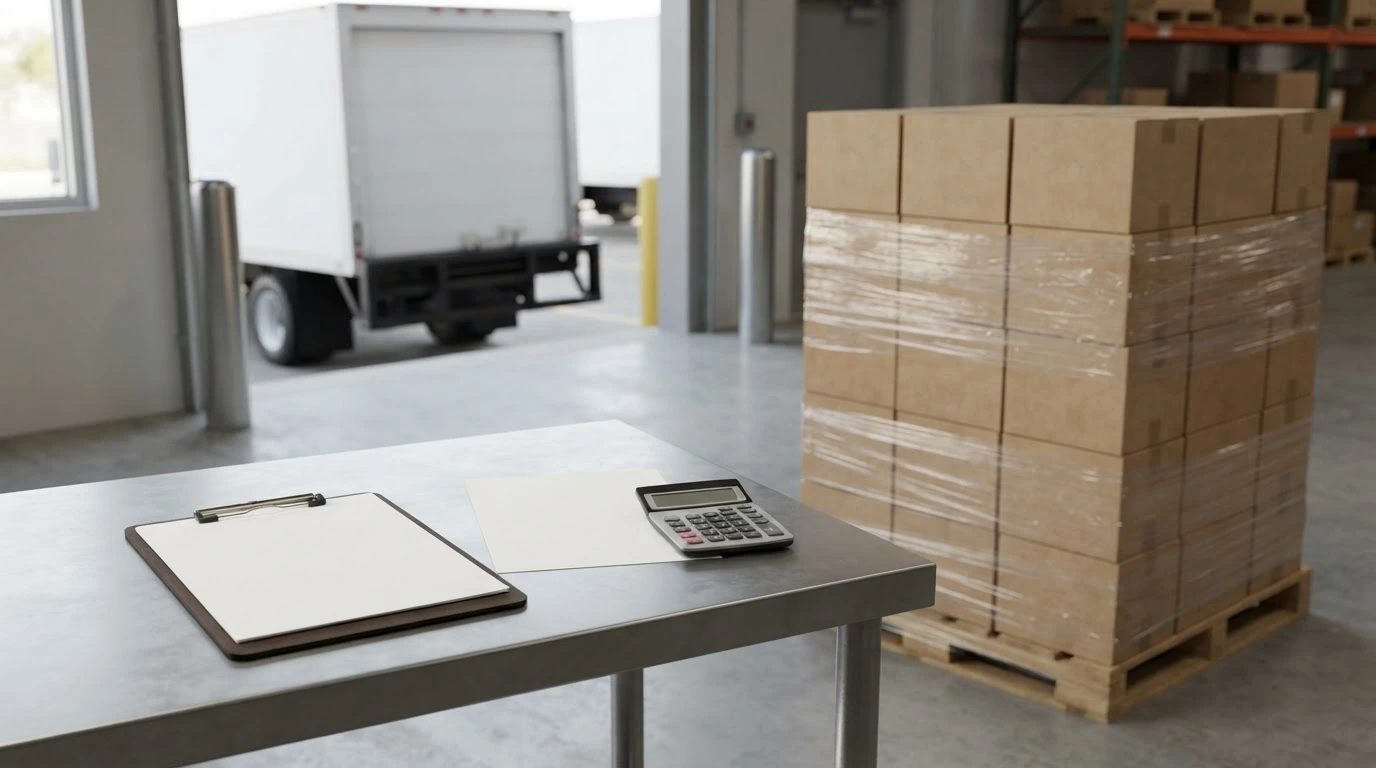
Freight Delivery to a Storage Facility
Plan freight delivery to a storage facility by confirming acceptance, access, unloading equipment, appointments, carrier rules, and custody before pickup.

The short answer
Freight can be delivered to a storage facility, but the facility’s name alone does not tell a carrier how to handle the stop. A staffed commercial warehouse with a dock may function like an ordinary business delivery. A self-storage property with a gate, no receiving crew, and no dock may be treated as limited access or as a separate self-storage accessorial under the selected carrier’s rules.
Before requesting a rate, confirm that the facility accepts freight and identify the receiving contact, access hours, vehicle restrictions, unloading method, appointment requirements, and exact point where the shipment will be released. Then quote the destination and any needed services as they actually exist. Do not assume that “commercial address” means dock delivery or that choosing one accessorial automatically includes another.
First determine what kind of facility will receive the freight
“Storage facility” can describe very different delivery environments. Use the address and operating conditions, not the label on the building, to plan the shipment.
| Receiving environment | Questions to resolve before quoting |
|---|---|
| Staffed warehouse or third-party logistics facility | Is there a receiving dock, a forklift, a receiving department, a purchase order or appointment process, and a person authorized to sign? |
| Self-storage or mini-storage property | Will management accept freight, or must the renter be present? Can a tractor-trailer enter and turn around? Is there a gate, code, height limit, or restricted access window? |
| Job or project staging location | Is the freight being released to a staffed receiver, and is the unloading area safe and accessible to the carrier’s vehicle? |
| Carrier terminal or another temporary holding point | Is this truly a delivery to a consignee, or is the freight remaining in carrier custody under a hold, will-call, reconsignment, or storage rule? |
The last row matters because a delivery to an independent storage business is not the same as freight stored by the carrier after delivery cannot be completed. Those situations can have different documents, responsibilities, and charges.
Carrier treatment is not universal
Current carrier publications show why a shipper should check the governing tariff instead of applying one rule to every storage address.
FedEx Freight’s 2026 rules tariff specifically includes individual mini-storage units in its examples of limited-access locations. XPO’s 2026 tariff likewise includes self-storage facilities, whether warehouses or storage units, within its limited-access rule. Old Dominion’s 2026 accessorial guide takes a different presentation approach: it lists pickup or delivery at self-storage warehouses as its own service, alongside separate entries for limited access, appointment or prior notification, hydraulic liftgate, inside delivery, and redelivery.
These examples establish a useful principle, not a universal classification. The selected carrier’s current rules, the shipment-specific quote, and any customer pricing agreement control. Estes also notes that accessorial services go beyond normal pickup and delivery and that exceptions may appear in a customer’s pricing agreement or contract.
Match each service to an actual condition
A storage stop may need more than one service, but the services answer different questions.
- Limited access or self-storage service: Does the carrier’s tariff classify this destination type or its access conditions as nonstandard?
- Liftgate: Is powered equipment needed to move the handling unit between trailer height and ground level because there is no usable dock or forklift? Confirm that the freight fits the carrier’s liftgate limits.
- Appointment or prior notification: Must the carrier contact the receiver or secure a delivery window before arriving? Notification and a firm appointment are not necessarily the same service.
- Inside delivery: Must the freight move beyond the carrier’s normal delivery point? Never infer the included distance, threshold, or labor from the phrase alone; check the carrier’s rule.
- Redelivery: What happens if the carrier arrives but cannot complete delivery because the receiver is absent, the gate is inaccessible, or unloading is unavailable?
Selecting liftgate service does not necessarily cover limited access, an appointment, inside placement, or redelivery. Conversely, a self-storage accessorial does not prove that a liftgate is needed. Quote only the conditions that apply, while disclosing the destination accurately enough for the carrier or rate provider to identify its own rules.
Confirm acceptance and access in writing
Before the freight moves, ask the facility these questions:
- Do you accept palletized or crated freight for this tenant or customer?
- Who is authorized to receive and sign for it?
- Must the renter, consignee, or another named person be present?
- What delivery days and hours are available, and is an appointment required?
- Can the expected tractor and trailer enter, turn, and exit safely?
- Are there gates, codes, security check-ins, height restrictions, narrow lanes, or other access controls?
- Is there a dock, forklift, or other unloading equipment? If so, who operates it?
- Where will the carrier place the freight, and who moves it from that point into the storage space?
- Does the facility require a reference number, tenant name, unit number, release authorization, or other receiving instruction?
- What are the facility’s separate receiving, handling, or storage terms?
Record the receiving contact’s name and phone number in the shipment instructions where the carrier’s process allows it. Avoid putting a gate code or other sensitive access credential on a public-facing label; give operational access information through the approved carrier or facility channel.
If the facility will not accept freight, do not address the shipment there and hope the driver can leave it. Arrange a staffed consignee, terminal pickup if the carrier offers it, or another delivery plan before pickup.
Keep carrier storage separate from facility storage
Two charges with similar names can arise in different places:
- Facility storage or handling comes from the independent warehouse or self-storage provider under its agreement with the customer.
- Carrier storage may arise when freight remains in the carrier’s possession because delivery cannot be completed or instructions are delayed, according to the carrier’s tariff.
XPO’s current rules, for example, contain separate provisions for redelivery and for freight held in carrier possession. That does not establish when another carrier starts charging or what another facility bills. It does show why a missed appointment, unavailable receiver, or inaccessible gate can create more than a simple scheduling inconvenience.
Ask who will pay each category and obtain both sets of terms before shipping. A freight quote generally should not be treated as a quote for the storage facility’s rent, unloading labor, or later movement out of storage unless those items are explicitly included.
A practical decision example
Suppose a distributor wants to send one wrapped pallet to a customer’s rented self-storage unit. The property is a commercial address, but that fact does not settle the delivery plan.
The distributor first confirms whether property management will accept the pallet or whether the customer must be present. Next, it checks whether the delivery vehicle can clear the gate and maneuver on site. The property has no dock, so the distributor asks whether ground-level unloading is required and whether the handling unit is suitable for the selected carrier’s liftgate service. It also confirms the receiving window and the exact person who can sign.
Only after those answers are known can the shipper represent the stop accurately in a quote. The applicable carrier may treat the address as limited access, self-storage, or another nonstandard destination, and may price liftgate or appointment service separately. The example does not depend on a universal fee or carrier label; it depends on disclosing the real receiving conditions.
Prepare the shipment details for a quote
Have the following information ready:
- Origin and destination postal codes and full street addresses
- The destination’s business name and receiving contact
- Commodity description and NMFC item or freight class when properly known
- Packaged length, width, height, weight, and number of handling units
- Packaging type, such as pallet, crate, or other unitized freight
- Dock and unloading-equipment availability at both ends
- Whether the selected carrier needs to evaluate limited access, self-storage, liftgate, appointment, notification, or inside delivery
- Delivery hours, access restrictions, and any approved receiving references
- The party responsible for freight charges and any separate facility charges
NMFTA explains that freight classification can consider density, handling, stowability, and liability. Accurate packaged dimensions, weight, commodity information, and handling-unit details therefore matter independently of the destination. Do not guess a class from the fact that the shipment is going into storage.
Build the quote around the real receiving conditions
The best way to reduce avoidable delivery friction is to resolve acceptance, access, equipment, and scheduling before pickup. Reconfirm the facility’s instructions near the planned delivery date, and compare the resulting shipment under the selected carrier’s current rules rather than relying on a generic storage-facility label.
Shipocity is backed by a team with more than 40 years of combined logistics experience. Through established industry relationships, the platform helps businesses compare competitive freight rates for their specific shipment.
When the facility details and shipment measurements are ready, build a freight quote using the actual delivery conditions.