Crate vs Pallet Shipping: Which Protects Freight Better?
Pallets are the LTL default for stable freight; crates enclose fragile, heavy, or export-bound loads. See how each changes your freight quote.
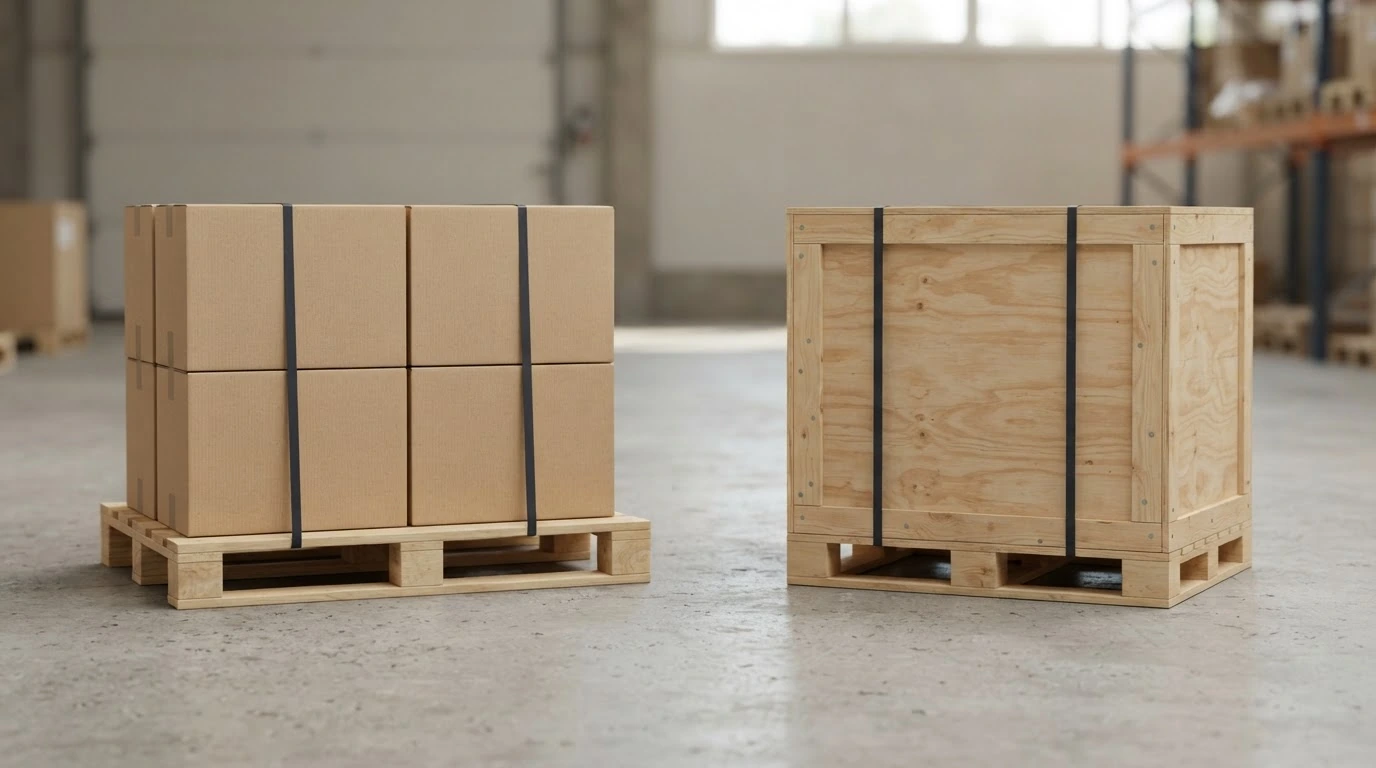
A well-built crate generally provides more enclosure and resistance to impact, puncture, and shifting than an open pallet load. That does not make a crate the right choice for every shipment. Stable cartons and other uniform goods may be adequately protected on a properly rated, secured pallet, while fragile, irregular, high-value, or heavy equipment may need a crate with internal blocking and bracing.
The better option is the package that protects the specific product, works with the carrier’s equipment and rules, and remains practical after its finished dimensions and weight are included in the quote.
The basic difference
A pallet is a handling platform. Products are placed on its deck and unitized with an appropriate combination of cartons, padding, edge protection, stretch film, bands, or other securement.
A crate is a rigid shipping container, commonly made from wood but also available in metal or plastic. It surrounds more of the product and can incorporate framing, panels, cushioning, blocking, and bracing. A crate may be attached to a pallet, built with an integrated forklift base, or designed with suitable fork openings. It is not accurate to assume that every crate simply sits on a separate pallet.
| Question | Palletized load | Crated load |
|---|---|---|
| Is the product enclosed? | Usually no; protection comes from product packaging and unitization | Usually yes; rigid panels provide an outer barrier |
| Can it include internal bracing? | Possible for particular loads | Common for machinery and irregular items |
| Does it add packaging weight and volume? | Yes | Usually more than an open pallet configuration |
| Is it automatically stackable? | No | No |
| Is it automatically carrier-compliant? | No | No |
Neither term guarantees quality. A damaged pallet with loose cartons is poor protection. A weak crate with the product free to move inside is also poor protection.
When a pallet is usually enough
A pallet is a practical starting point when the product is already protected by sturdy transport packaging and can be arranged as a stable unit. Examples can include uniform corrugated cartons, rigid containers, or products designed for palletized distribution.
The finished load should:
- Stay within the supported pallet footprint
- Remain stable when lifted and moved
- Use a pallet rated for the load and handling method
- Protect the product from contact with deck gaps, fasteners, and handling equipment
- Use securement suited to the product rather than relying on a loose layer of film
- Meet the carrier’s stackability and packaging requirements
FedEx’s current pallet guidance emphasizes strength, stiffness, durability, functionality, and load securement. It also warns against overhang because it reduces package support and exposes product edges to damage.
An open pallet saves the weight and space of crate walls, but it also leaves more of the shipment exposed. If ordinary contact, vibration, compression, or a nearby load could damage the product, the packaging needs more protection than a basic wrapped pallet provides.
When a crate provides useful protection
FedEx describes shipping crates as heavy-duty containers often used for big or bulky items that need added protection from vibration, shock, and shifting. A crate can provide a rigid exterior and attachment points for internal protection.
Crating is worth evaluating when the shipment includes:
- Fragile surfaces, glass, finished furniture, or sensitive components
- Machinery that must be immobilized
- An irregular shape that cannot form a stable pallet load
- A product vulnerable to puncture or contact from adjacent freight
- A high-value item that needs more physical security
- Long, flat, or top-heavy freight that needs an engineered support structure
The crate has to be designed around the product. Empty space without blocking allows movement. Excessively tight contact without cushioning can transfer shock directly into the item. Fasteners, framing, deck strength, center of gravity, and the locations used for lifting all matter.
FedEx’s crate guidance for engines illustrates the principle: drain fluids, mount the engine securely to a pallet deck, block and brace it internally, and place sturdy expendable packaging around it. That is a product-specific example, not a universal crating recipe for every machine.
A crate is not automatically stackable
Rigid walls and a flat top can make some crates suitable for stacking, but stackability depends on the crate design, the product, the supported load, and the carrier’s rules. A decorative plywood shell does not prove the top can bear freight.
If a crate must remain nonstackable, declare that during quoting. Do not add an unsupported flat lid simply to make the shipment look stackable. The structure has to carry any allowed top load without transferring damaging force to the product.
The same caution applies to palletized cartons. A level top and strong cartons may support stacking, while a pyramid-shaped or fragile load may not. Confirm rather than infer.
How the packaging choice affects a quote
The carrier prices and handles the finished unit, not the bare product. Crating commonly adds:
- Lumber, panels, and fasteners
- Blocking, bracing, and cushioning
- Length, width, or height
- Gross weight
- A different stackability or handling profile
Those changes can affect density, classification, capacity use, and service options. They do not mean a crate always costs more or receives a higher freight class. The result depends on the shipment and the current carrier and NMFC rules.
Packaging type alone does not assign freight class. NMFTA’s current guidance for a mixed-freight package, skid, or crate explains that density may be calculated by handling unit, or from total weight and cube when shipping papers provide only shipment totals, unless otherwise provided. Commodity provisions and other classification factors still matter.
When comparing an open pallet with a crate, obtain the dimensions and weight of both finished designs. Do not compare the product-only measurements for one option with packaged measurements for the other.
International wood-packaging requirements
Solid wood crates, pallets, and dunnage used in international trade may be regulated as wood packaging material. Requirements depend on the destination and the material used.
USDA APHIS explains that U.S. exporters can obtain ISPM 15-compliant wood packaging by purchasing properly treated and marked material, manufacturing through the approved program, or using a registered heat-treatment or fumigation facility. The official mark shows that the wood packaging was treated under the compliance program. Manufactured wood products may be treated differently from solid wood, so confirm the exact destination and material requirements before export.
Do not create or apply an ISPM 15 mark yourself. APHIS states that the producer must be registered with an accredited inspection agency.
Common decision mistakes
Choosing by product value alone
Value matters, but vulnerability and handling matter too. A valuable solid component may need less enclosure than a lower-value delicate assembly. Declared value and packaging solve different problems: packaging protects the freight physically, while valuation and carrier liability are governed by the applicable shipping terms.
Assuming more wood means better protection
Crate configuration matters more than simply adding material. Poor fastener placement, weak corners, inadequate bracing, or unsupported concentrated weight can defeat a heavy-looking build.
Ignoring the base
The carrier still needs to move the crate. The base must support the total load and provide compatible access for the handling equipment. FedEx’s general packing guidance says a crate should be banded to a pallet or include forklift openings.
Measuring before packaging
Use the farthest points of the completed load. Include runners, bands, cleats, handles, protrusions, and the pallet or crate base. Weigh the product and every packaging component together.
Treating a carrier example as an industry-wide rule
Packaging guides are valuable, but specific requirements may differ by carrier, service, lane, commodity, and equipment. Confirm the selected option before tendering an unusual or high-risk handling unit.
What to gather before requesting a quote
Prepare:
- Packaging type and construction
- Finished length, width, and height of each handling unit
- Gross weight of each handling unit
- Pallet or crate count and piece count
- Commodity description
- NMFC item and freight class when known
- Stackability and special handling requirements
- Origin and destination ZIP codes
- Dock, forklift, pallet-jack, and liftgate availability
- Residential, limited-access, inside, appointment, or other requested services
- International destination and wood-packaging compliance details when applicable
- Declared value or requested cargo-liability options when applicable
Shipocity is backed by a team with more than 40 years of combined logistics experience. Through established industry relationships, the platform helps businesses compare competitive freight rates for their specific shipment.
Once the final packaging dimensions and weight are ready, get a freight quote and create your Shipocity account.